Tuesday, November 08, 2005

St. Vincent de Paul, Kansas City, Missouri

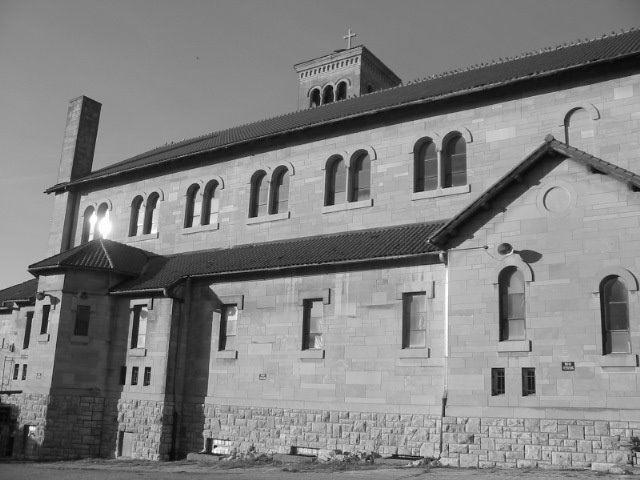
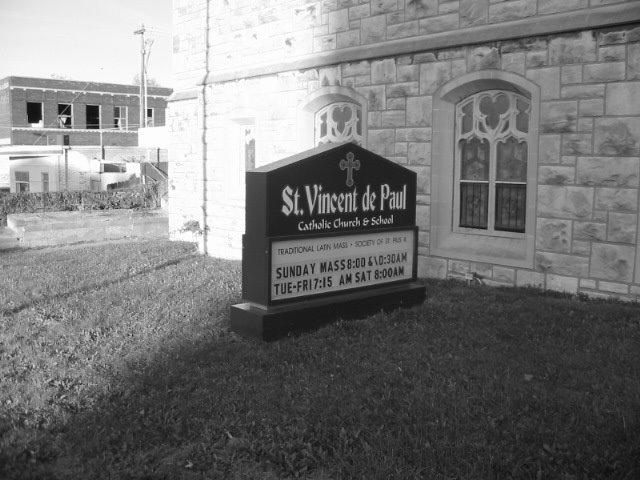
From the two saddest cases I know of--Holy Name and Blessed Sacrament, to one with some hope: St. Vincent de Paul at Flora & Linwood (the 3100 block of the Paseo) was built, appropriately enough, under the guidance of the Vincentians in 1922, and closed by the diocese at some point before 1980; however, it was "rescued" by the SSPX with the help of a protestant preacher who served as intermediary, and it has been reasonably well-maintained by the SSPX for the last twenty-five years. The SSPX began operating there in 1981, seven years before the . . . incident. Somehow, all the furnishings, statues, and windows stayed with the church, and because it's in SSPX hands, one can actually get inside to see the interior (and reverence the Blessed Sacrament, of course).
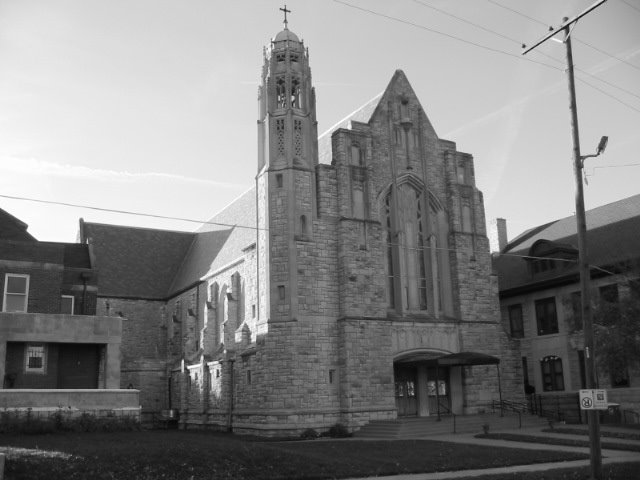
This is not the prettiest church in the Diocese of Kansas City-St. Joseph (Our Lady of Perpetual Help/Redemptorist, is the hands-down prettiest, and Our Lady of Sorrows--with the altarpiece that inspired Joyce Hall to create Hallmark's gold crown logo--is perhaps in second place).

St. Vincent de Paul is not richly appointed like those other two churches. It seems like the builders spent all their money on the structure, with little left for the interior. However, it's certainly the most majestic of all of the Kansas City's churches, and perhaps the most authentic, least "Americanized" tribute to the gothic form around town. I don't know much about architecture, but it feels very English (whereas Redemtorist feels unmistakably French, and Sorrows is, well, kind of northern Italian on the outside and kind of baroque German on the inside. St. Vincent's has a long nave, a cedar roof and reredos, a nifty baptistry, functional side altars, and a number of confessionals (not as many as Redemptorist, though). The church actually has a choir area with a dozen or so stalls behind the altar rail, between the transcept and the sanctuary. This next picture, taken from the west side of the Paseo, shows just the choir and gives you a better sense of scale. The Vincentians were undoubtedly practical men who where making the most of the land they had to work with, but it's a real shame that the school building was built so close to the church that it interferes with the view.

Anyways, St. Vincent's may not be the best backdrop for wedding pictures, but it's the kind of place you can imagine a duke receiving his coronet in, the sort of place being pillaged by Henry VIII's and Elizabeth's henchmen, and the kind of place you can almost hear Gregorian chant echoing in (of course, there's no imagination necessary on that last count. I suppose one really does hear chant every Sunday there, although I've never had occasion to be there during a High Mass).

I found a little information on this church, in back issues of The Angelus magazine, that I'm linking to, noting the purchase and rededication of the building by the SSPX. Whatever yout think about the SSPX situation, you have to be happy that the building is intact and in Catholic hands with a real chance of becoming a canonically regular church again someday.

One can only hope that, when the rift between the society and the hierarchy is resolved and as the old Mass becomes more widely available, this beautiful church on an ugly corner of Kansas City isn't forgotten.
If you've got more information on the building, do please add a comment or email me.


[Remember, you can see these photos enlarged by clicking on them]

UDPATE DECEMBER 10, 2005

Just a little more information on St. Vincent de Paul, which I first featured on November 8—I didn't get all the way through the entry before I got the "Really, sir, we're closing and you'll have to leave" speech at the library last week.In 1975, the parish was suppressed and folded in with Holy Name and Annunciation to create the Church o' the Risen Christ. At the time of closure, The Vincentians deeded the parish to the diocese, with it still subject to $80,000 in debt. More to come, but I do have one rather catty comment for now. I was inside the Church a couple of years ago, and again recently, and I noticed that in that time, someone painted around the small windows (in the side aisles) in some sort of dusty rose or mauve or something. Whatever they were trying to do, it didn't work. Or perhaps one of the former KC-SJ bishop's church decorators broke into the church to play a trick on the SSPX?

UPDATE DECEMBER 27, 2005

More on St. Vincents
Well, I can eliminate the detailed history of
St. Vincent de Paul Catholic Church from my "to do" list. Someone brought the SSPX newsletter, The Regina Coeli Report, (CLICK HERE) for this month to my attention. Their article, occasioned by the twenty-fifth anniversary of the acquisition of the abandoned church by the SSPX, is much thorough than I would have managed, even with a little more time in the library.

Monday, November 07, 2005

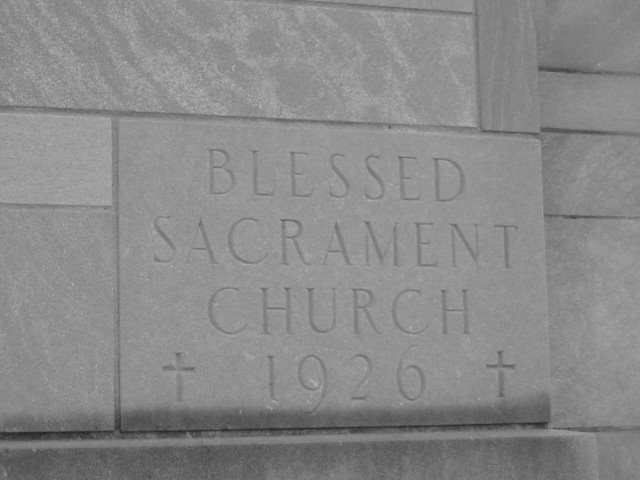
Blessed Sacrament, Kansas City, Missouri


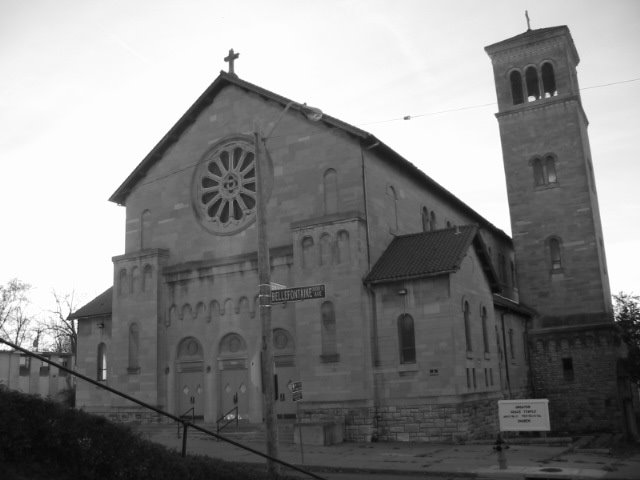
Here's an impressive and balanced Italian Renaissance specimen, (with Romanesque features all around) the Greater Grace Temple Apostolic Pentecostal Church, once Blessed Sacrament Church, at 39th and Bellafontaine (not to be confused with Blessed Sacrament at 20th and Parallel Pkwy in Kansas City, Kansas, still a parish, current home to the FSSP Latin Mass Community, St. Rose Philipine Duschene).

When was it closed? I don't know. Why was it closed? I don't know. I will say that the adjacent school must have really been popular in its day. You can tell it was added onto more than once, and a second building, also a school or a convent of apparently 1950's-ish design, is just south of the church. What a pity. It's obvious from the outside that all the stained glass has been removed, and while one can still see some Corinthian capitals on the columns inside, one imagines that a congregation like "Greater Grace Temple" is iconoclastic. There probably isn't much of the original beauty left inside.

Do share anything you know about this church with me, and if you have any other suggestions--churches on the Missouri side in Kansas City, do make a comment. And remember, east-coasters and Europeans, don't make fun of us because our ruins aren't as old as yours are.

UPDATE DECEMBER 5, 2005

I had a chance to review This Far by Faith, vol. 2, (1992, Rev. Charles Michael Coleman, ed.) at the central public library this weekend. Unfortunately, the book doesn't circulate, and I only allowed myself an hour before the library closed. However, in that hour I found some interesting information that I'll post on some of the closed churches I've visited, and some leads on other churches I'll try to find in the next few weeks.We'll start today by looking back at Blessed Sacrament. . . . . It was designed by Archer & Goyd, and was one of two buildings that received recognition for outstanding design in 1927 (the other being a Jewish synagogue). The cornerstone was laid in 1927, and it was dedicated in October 1928. It was built of Bedford stone in the Italian style at a cost of approximately $150,000. It was the first cut-stone church in Kansas City. It seated 800, and was extensively stenciled inside by Dante Cosentino. The parish paid off the debt from the original building in 1941. The school thrived for many years, but then, startin in the 1960s (concurrently with the Spirit-of-You-Know-What) went through a period of decline and it was consolidated with the school of St. Louis parish in 1974. The last Mass was said in the parish on February 3, 1991 by the last pastor, Rev. Robert H. Stewart. There are many other details in the book, for those of you who might be interested.

UPDATE FEBRUARY 12, 2006

Wow. A more careful perusal of This Far by Faith, including volume 1, led to the discovery of some magnificent pictures by Joe A. Stornello in the color plates there (Let's all give Mr. Stornello a "huzzah" for some great photography). The interior of Blessed Sacrament was as well-balanced and aesthetically uplifting as the exterior. Note that there's no newfangled altar obscuring the view of the high altar in these photographs. There's no altar rail around the sanctuary, though. We can see some of Cosentino's stencilling, and his angels on either side of the apse (a descendant of Dante Cosentino told me that about the only place one can still see his work is Our Lady of Sorrows on Gillham Road.

I cannot begin to wonder what Bishop Helmsing (1962-1977) and Bishop Sullivan (1977-1993) were thinking as seminaries, rectories and pews emptied around town and they closed down and wrote off such beautiful edifices, all the while pushing such un-Catholic ventures as St. Mark's Ecumenical Parish and signing off on parish building projects like St. Robert Bellarmine and St. Thomas More and St. Charles Borromeo and some really horrible church out near Belton whose name I forgot. Were Helmsing and Sullivan filled with hope? Did they REALLY think it was a New Springtime?

It brings tears to my eyes to think that this place was abandoned, as far as Catholic worship goes, and while the new churches built south and west are so hideous . . . such as . . . I dare not start the list.

Sunday, November 06, 2005

League of Evil Traditionalists

Pledgeship is over. I have finally been admitted into the League of Evil Traditionalists.

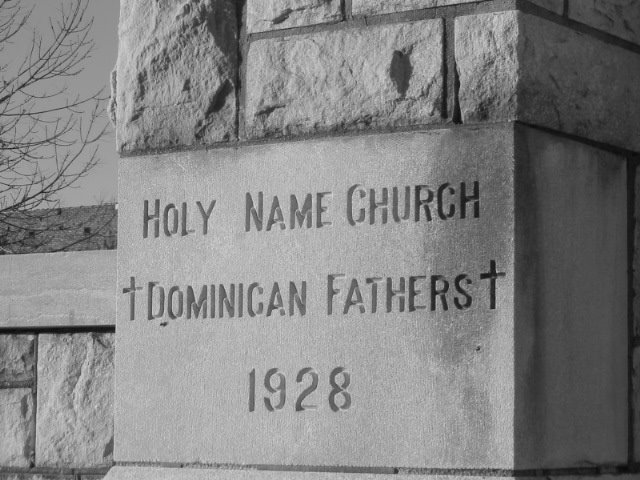
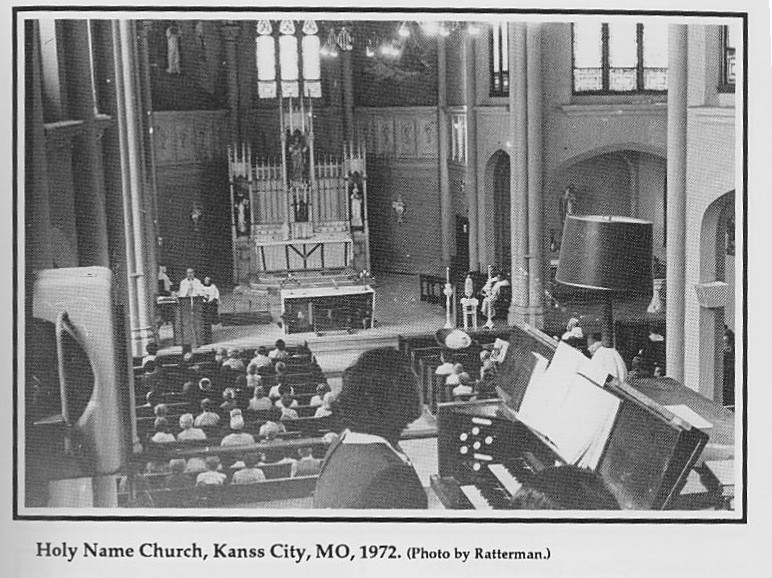
Holy Name Church, Kansas City Missouri

Took an hour today to get some fresh air and drive about Kansas City, Missouri. I did so with my digital camera and an idea to get some photographs of Catholic churches in Kansas City which have been shuttered. This week I'll feature four of them.

I just got back in from my drive, and now I'm kicking myself because I should have taken (in addition to these low res B/W photos suitable for my blog) some higher-resolution pics, and even some color shots.


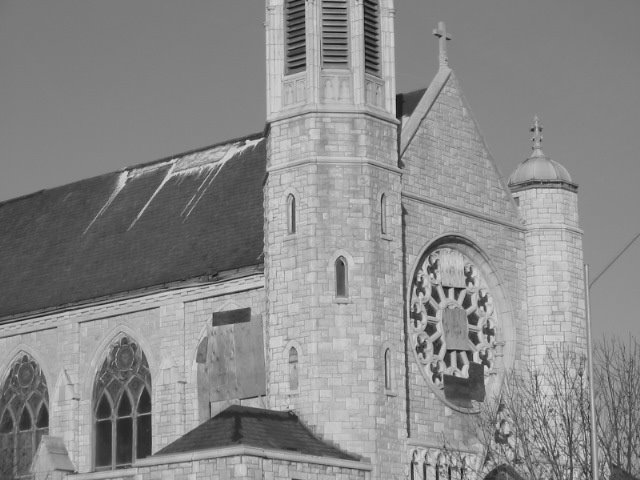
I'll start today with Holy Name Church, at 23rd & Belton, built under the direction of the Order of Preachers. I'm starting with Holy Name because I can see it from my office, and years ago, over lunch, I hunted it down. When I first found it, in 2001, there was a chain link fence around it, and there were gaping holes in the roof and windows. Now it's the Future Home of New Day Missionary Baptist Church, Rev. Frank L. Selkirk, Choir Director, the Church where the LOVE of JESUS is SHINING THROUGH. Mr. Selkirk's congregation doesn't appear to be prosperous, but at least, they managed to put up some plywood over the holes, and it's not the sun that's shining through.

Whose fault is it that this church is now, less than a century after it was built, on its way to becoming a ruin? That's a complex question. Partially, Eisenhower's to blame, because his interstate highway system made it possible for people to live in places like Gardner and Belton and Excelsior Springs and still commute to work. Partially, it has to be the Bishop and the Dominicans, or whomever was entrusted with the parish, for their failure to evangelize the newcomers to the neighborhood as the original parisioners moved out to the burbs. But then, sometimes, these things just happen. Sad nonetheless.

Please, especially if you're from the Kansas City area, comment on these--let me know what YOU know about the parishes and their demise, and make some suggestions for other churches that I might want to feature.

And those of you from the east coast or Europe, do spare us poor midwesterners your scoffing at our eighty-year-old buildings. Just because our ruins don't date from the 17th Century, or the 12th Century ruins doesn't mean that we can't be saddened by them.


FYI, you can get a better look at these pictures by clicking on them.

UPDATE DECEMBER 6, 2005:
Holy Name, the very first closed church I featured here, has an interesting history. After reading the entry in This Far by Faith, I could only conclude that Holy Name (impressive as it is) was, perhaps, a church that should never have been built. If you build it, they don't always come. Although plagued by money problems from the beginning, the Dominicans planned a huge English Gothic church complete with a massive central spire over the transept. In 1911, the foundations and the basement were built at a cost of $56,587. Money ran out, so the basement was covered over and work stopped for 14 years. Finally, a new architect was hired, H. W. Brinkman of Emporia, Kansas, who modified and saw the church built in 1925. It was designed to seat 1,000. Instead of the central spire, the smaller spire on the façade was constructed. The final cost was $175,000, of which $75,000 was borrowed from the diocese. Money problems continued, and the Dominicans schemed in various ways to draw people in—even with plans for a bowling alley in the basement. It was reported that at one time before closure, collections ran around $175 on a Sunday with four Masses. Finally, in 1975, the parish was suppressed and folded in with Annunciation and St. Vincent de Paul (two other churches I've featured) to form "Church of the
Risen Christ" at the Annunciation site. In fifty years, Holy Name parish only managed to repay $23,000 of its diocesan debt, and the Dominican order wrote off a much bigger loan. On July 15, 1975, the building was sold to a congregation of the Church of God in Christ, which (in order to conserve energy) built a shell inside the building in which they held their services. It is reported that the stained glass windows were not visible from inside the shell. If you're ever in the Central library or find a copy of This Far by Faith near you, you ought to look up the entry for Holy Name, where you'll find, among other things, a rendering of the church as originally planned, with the central spire. It would have been breathtaking.

UPDATE FEBRUARY 14, 2006
I've added an interior shot (from after the sanctuary was messed up in the Spirit of Vatican II, as you can tell) and also --one of the more interesting things in This Far by Faith, a rendering of the church as it was originally planned. One more interesting bit of detail from a closer reading of the book is that there was a tear-gassing incident in April 9, 1968, the day of Martin Luther King, Jr.'s, funeral. It was Tuesday of Holy Week, and the parish was hosting a dance in the basement, and for whatever reason, the cops fired
six cylinders of tear gas inside. That incident, and other, touched off rioting in Kansas City. Among other questions I have about this incident is "why on earth would you host a dance on Tuesday of Holy Week? Was this a run-up to the Good Friday carnival? There's a subtext to the story of Holy Name if you read the article carefully, and that is that the Dominicans were losing their focus on teaching the Catholic faith, and that loss of focus (as well as general "white flight" to the suburbs) contributed to the demise of Holy Name.

Saturday, November 05, 2005

The Gunpowder Plot...


It's Guy Fawkes day, when heretics all over England celebrate one of the major events in the destruction of Catholic, humane, idyllic Britain and the beginning of the protestant nightmare that has brought that "garden, that demi-paradise" to the point of, well, Charles and Camilla, Tony Blair, the Spice Girls, Rowan Williams and company.

I wondered in a post on October 14, a couple of weeks ago how Catholics should mark the day, or respond to those who celebrate it (an abstract question here in the US, but more practical in the UK, where people still light bonfires, set off fireworks, and don Guy Fawkes masks every Nov 5). I actually had a response to that post a few days ago, from Robert, who sent me the following link:
http://www.godspy.com/reviews/November-5-Guy-Fawkes-Day-Go-Out-with-a-Bang-by-John-Zmirak.cfm

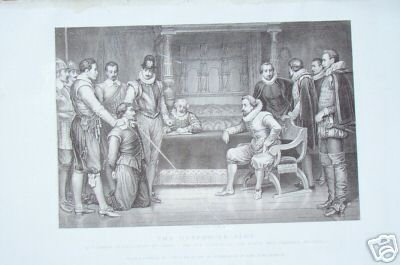
The image above is of the small engraving I purchased a few weeks ago, depicting the interrogation of Guy Fawkes before James I. Unless you're some Commonweal-reading, kumbaya-singing pacifist, you gotta admire Guy for trying the Gunpowder Plot, even though he ended up being duped.

Since this is such a banner day for the English "reformation," I suppose this is a good day to plug a great work of counter-propaganda by a nineteenth-century protestant, William Cobbett's History of the Protestant Reformation in England and Ireland. (actually, I hear that Mr. Cobbett crossed the Tiber at some point after finishing this book). TAN, a publisher worthy of support, has the book on sale $16 right now. It's $21 on Amazon, and it's always better to purchase books from small publishers like TAN directly, because the margins are better for them, and consequently, they have more resources to keep valuable books like these in print.

Friday, November 04, 2005

Waugh on being RIGID

"It is better to be narrow-­minded than to have no mind, to hold limited and rigid principles than to have none at all. That is the danger which faces so many people today‚ to have no considered opinions on any subject, to put upwith what is wasteful and harmful with the excuse that there 'is good in everything' ‚ which in most cases means an inability to distinguish between good and bad."
--Evelyn Waugh

This was forwarded someone who received it from a friend as part of an interesting tongue-in-cheek article: it was an elaboration on the definition of "rigid" in A MODERN SEMINARIANS' DICTIONARY, Published in Fidelity, September 1987, pp. 23-25. If I didn't fear copyright infringement claims, I'd post the whole thing here, as it's sad and humorous at the same time.

[Added Nov 6: after rereading the email that was forwarded to me, I see its source: Domenico Bettinelli featured this on Bettnet on Friday.]

I wish I knew where they got the Waugh quote. WAIT A MINUTE, this is the internet age. Let me google it . . . oh, it was an essay on tolerance published in 1932. I can't tell where it was published.

Tuesday, November 01, 2005

Synod Expectations

Great post on unrealistic expectations for the synod by Hilary at The Devout Life today.

Although I looked forward to it months ago, by the time it rolled around, I couldn't muster enough interest to follow it closely--perhaps an inchoate feeling along the lines of what Hilary stated so clearly.

Really, what could be expected, when the American synod delegates were chosen from the "old guard" of Bernadin's boys, men like Skylstad (ugh, it hurts so much to think of the man who, although he's gambled and lost a century's worth of material patrimony in his own diocese, is somehow worthy of being the USCCB president) and Wuerl and Mahoney? No doubt the same sort of men were sending the same sort of delegates from around the globe.

Saturday, October 29, 2005

Why Bishop Sheridan ?

When Cardinal Mahoney or his ilk make statements of religious indifferentism, or statements that play into the hands of the purveyors of syncreticism, I can't think too much new harm is done. Those sorts of fellows have said those sorts of things so many times that Catholics who hear them speaking have already made up their minds and written them off as false pastors, or have already bought into their way of thinking.

But when a respectable Bishop who's demonstrated some courage and independence preaches anything that resembles religious indifferentism, that seems to be still dangerous. Which brings us to Bishop Michael Sheridan of Colorado Springs, who was one of the few men in the American college to indicate he would dutifully enforce Eucharistic discpline in his diocese last fall.

Apparently, a lay official of the Colorado Springs diocese said that Catholics should not attend Protestant worship services (even if they also attended Catholic Mass) as part of an interview for an article was published in the October 17 issue of the Colorado Springs Gazette. (I couldn't find this online) Apparently, he also penned an article to the same effect for the Colorado Catholic Herald, the diocesan newspaper (also not online). Bully for Mr. Howard! It's shouldn't be a surprise to see a Catholic chancery official saying such a thing. It goes without saying that regularly attending Prot services is a no-no, even for those of us who may occasionally attend a Prot wedding, funeral or (in very extraordinary circumstances, after fulfilling ones obligation to assist at Mass) another Prot service . . . or so we thought, eh?

Well, apparently we thought wrong, says the otherwise-distinguished Bishop Sheridan in the October 21 Gazette article. Mr. Howard's comments do not represent Bishop Sheridan's "thinking on the matter." Apparently, we need no longer worry about being confused, and it's not true that the Church has no longer forbade any intercourse with those who professed a mutilated and corrupt version of Christ's teaching. We can, in the evangelical capital of the World, Colorado Springs, regularly to go hear a "prosperity gospel" from a hip twenty-something preacher, or take comfort in a Baptist minister who assures us we can be SAVED notwithstanding whether we're diddling our intern, because of sola fides, once saved/always saved, or we can weekly watch some woman play-act the eucharistic sacrifice is an episcopalian ecclesial community . . . er, church . . . without danger to our souls.

I'm sorry your Excellency, I was taken in by Mr. Howard and those who think like him (you know, Pius XI and those clowns). I'll try to lighten up when I drive through your jurisdiction . . . really I will. Anything to keep the peace with Chuck Colson and your evangelical friends around town, right?

Wow, 1,000 hits.

Wow, I have 1,000 hits since I started counting. I'm not going to shower myself with praise over the attention I've drawn to myself, like Rocco at Whispersintheloggia (although he's drawn many, many times more attention to himself than I have). But I will reiterate the shock I feel that anybody reads this thing. Five hundred unique readers over the last few weeks, and a dozen or so regular readers, is more than this sloppy blog merits.

Thursday, October 27, 2005

Wikipedia on the Cappello Romano

Here's more on ecclesiastical headgear, again from Wikipedia via answers.com:

Cappello Romano

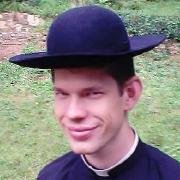
A cappello romano (literally Roman hat) is a hat with a wide, circular brim and a rounded rim worn by Catholic clergy. It is made of either beaver fur or felt, and lined in white silk. Unlike many other articles of ecclesiastical attire, it serves no ceremonial purpose, being primarily a practical item. (The galero is a ceremonial wide brim hat no longer worn.) The wearing of a cappello romano is optional, but it is never worn during services. It is generally uncommon outside of Rome today.

There are some, mostly minor, differences in the designs of cappelli, depending on the rank of the wearer. The
pope wears a red cappello with gold cords. All other clerics wear black cappelli. A cardinal may have a cappello with red and gold cords with scarlet lining. A bishop's may have green and gold cords with violet lining. A priest may substitute black lining for his. Cappelli worn by deacons and seminarians have no distinguishing items.

This entry is from Wikipedia, the leading user-contributed encyclopedia. It may not have been reviewed by professional editors (see
full disclaimer)

Wikipedia on the galero


In order to shed light on the great darkness regarding ecclesiastical headgear, I offer the following from wikipedia, via Answers.com

Galero
Plural galeri.
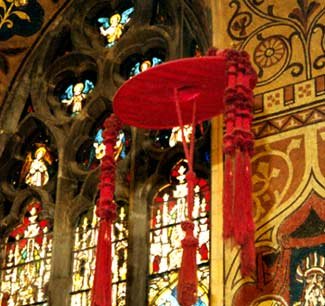
Galero, in the Roman Catholic Church, is a large, broad-brimmed tasseled hat worn by clergy. Over the centuries it was eventually limited in use to individual cardinals as a crown symbolizing the title of Prince of the Church. When creating a cardinal, the Pope would crown the candidate with a scarlet galero in consistory.

Second Vatican Council
In
1969, a papal decree following the Second Vatican Council ended the use of the galero as an act of humbling the Church hierarchy. It was deemed that by removing such elaborate regalia, the people could better identify with their pastoral leaders. Today, only the scarlet zucchetto and biretta are placed over the heads of cardinals in consistory. However, some cardinals continue to obtain the galeros privately so that the old ceremony of its suspension over their tombs may be observed.

The galero is hung forever over the congregants of a
cathedral, where they remain until they are reduced to dust, symbolizing how all earthly glory is passing.

Holy Name Cathedral in
Chicago, Illinois, the Cathedral Basilica of Saint Louis in Saint Louis, Missouri, and the Cathedral of St. Matthew the Apostle in Washington, D.C. are three Cathedral churches in the United States that hang the galeros of past Cardinals on the ceilings.

The galero (or "ecclesiastical hat") is still in use today in ecclesiastical heraldry as part of the achievement of the coat of arms of an armigerous Roman Catholic cleric. It replaces the helmet and crest because those were considered too warlike for the clerical state. The color of the galero and number of tassels (sometimes termed houppes or fiocci) indicate the cleric's place in the hierarchy. A bishop's galero is green with six tassels. An archbishop's galero is also green but has ten tassels. Both patriarchs and cardinals have a galero with fifteen tassels, but the patriarch's is green while the cardinal's is red or scarlet. Even a priest uses the galero in his arms, but uses a simple black with two tassels. However, priests who hold additional offices, such as vicar general or abbot, or who have additional honors such as Chaplain of His Holiness gain additional tassels and different colored hats. Popes do not use a galero in their personal arms, rather the Papal Tiara and Keys of Saint Peter are used.

The depiction of the galero in arms can vary greatly, depending on the artist's style. Typically the top of the hat is a flat, and the brim is very wide. However, the brim can also be rendered much narrower, and the top can be domed. Such variants sometimes look like a
cappello romano with tassels, but in heraldry it is still considered a galero.

Caption for photo: Upon the death of a cardinal diocesan bishop, his galero is raised above the sanctuary of his cathedral church. This galero was raised in 1924 for Michael Cardinal Logue, Archbishop of Armagh in Ireland.

Wednesday, October 26, 2005

Assumptions

Isn't it interesting how people you work with or work for naturally assume that you, as a similarly educated, similarly situated person, agree with them on all the issues of the day. What smugness! I'm surprised by it (but then, I assume that nobody agrees with me on anything--quite the opposite of this sort of person).

Standing around the coffee pot at the office, I listened to one of the senior folks at my office going on and on to some folks about the decision of Paul Morrison to challenge Phill Kline in the Kansas Attorney General's election. As it has with this person in the past, shots were fired at the religious right.

I gave this person a big, knowing smile as walked by. I keep trying to make it obvious, without saying so, that "mild mannered me" is really a reactionary, theocratic, choleric, monarchist, right-wing nut. I wonder if this person hasn't picked up on it, or just doesn't care.

A Catholic Utilitarianism ?

This post is just to direct your attention to the exchange of comments following my post Any Catholics in the Boston Chancery?, wherein Jeff (perhaps with rather more vitriol than necessary) takes an impostor posing as Todd of Catholicsensibility to task for some rather un-Catholic comments on the latest scandal from Boston's Catholic Charities. There is displayed, unfortunately for the Church, the lack of basic moral reasoning that plagues the laity and all but (perhaps) the highest level of officialdom in the Church.

Monday, October 24, 2005

Pius XII in a galero (Cappello Romano?)*


The Evil Traditionalists at Traditio in Radice and Inquisitor Generalis (who still haven't deemed me worthy) are all focused on finding pictures of supreme pontiffs in galeros (galeri?), cappa magnas (cappae magnae?) and suchlike. Here's my humble offering from my semi-regular search of eBay for interesting pope prints--Pius XII in a galero.

In case you're interested, this photo is actually on sale at eBay.
Click here. (No commission earned). Pretty cool, but my wife is going to kill me when I get my print of Guy Fawkes from the UK (I forgot about ridiculous exchange rates as I was bidding), so I'll have to pass.

* Note added 10/27/2005: Actually Pius XII appears to be wearing a cappello romano, and one that is much less silly than that worn by the wikipedia model above.

Any Catholics in the Boston chancery?

Archdiocesan agency helps gays adopt children
October 22, 2005
BOSTON --The social services agency of the Archdiocese of Boston has allowed 13 foster children to be adopted by same-sex couples in the past two decades, despite Vatican teachings against homosexuality.
Silly me. I'm just a public school kid, and I don't know much serious moral theology at all, but obviously I know more than the Catholic Charities board or the Archbishop of Boston. I'll quote (without permission) from a priest I know, who recently applied the principle to another moral issue of our day:

Bonum ex integra causa, malum ex quocumque defectu. (Goodness arises from an integral cause, evil arises from any defect whatsoever)

What does this axiom mean? It means that the moral goodness or evil of an act can be determined by a thoughtful assessment of the act itself, as well as its attending circumstances. A good act, attended by good circumstances, is said to have an integral cause, and thus can be safely performed by Catholics; but however admirable an act may be in other respects, if even one of the circumstances is gravely evil, the act cannot be recommended to Catholics.

Well, Bishop Sean, there you have it.


Sunday, October 23, 2005

Is this blog abandoned? Not yet. . . Scheherezade.

Haven't posted in a few days. There certainly is a great deal to post about, locally and otherwise, but I've been too busy with real life. The demands of commerce and breadwinning are slightly greater than in past weeks, and we've had more activity here at the house. Also I'm reading EE Reynolds' book, St. John Fisher, which is taking longer that the typical large-type 180 pg Evelyn Waugh novel (although it's undoubtedly better for my soul). What I do have to say this afternoon really has nothing uniquely to do with being a traditionalist Catholic; sorry to disappoint.

Mrs. Curmudgeon and I went to the Kansas City Symphony on Saturday evening. It's the first time we've been in a few years. The program was ambitious for our little symphony: Richard Strauss's Don Juan, Ravel's Scheherezade, and Rimsky Korsakov's Scheherezade. The Strauss piece seemed (to my pedestrian ears) flawless, and the Ravel very good as well (although I had never heard the Ravel piece before and I'm not a huge fan of 20th century music anyways). Of course, in true middle-American fashion, a few dozen people clapped after the first movement of the Ravel piece. But, we Kansas Citians do catch on . . . there was no clapping between the second and third movements of Ravel, and no clapping between movements in the finale.

As for Rimsky Korsakov . . . he's at about the outer limits of my tolerance for Romantic music, but I like Scheherezade and Capricio Espagnol. How could anybody not? Even though Haydn, Corelli and Mozart are staples that get me through my week, a rousing round of Brahms or Rimsky Korsakov or Berlioz or another 19th century Romantic now and then is good to liven up my soul...like a nice prime steak after a few weeks of the better-for-me pork/chicken/hamburger/fish rotation.

The performance...WOW! You don't realize how complicated a piece like that is until you actually watch it (instead of just listen to it) performed. It wasn' t recording-perfect (I have a good recording of this piece). There was a hesitant entrance or two by the woodwinds and the assitant concertmaster missed a harmonic near the end of the last movement and marred a brilliant, horsehair-bustin' performance by the concert mistress. But it was really, really good. The concert mistress, the principal cellist, and the french horns were outstanding. I wasn't moved to tears like I am sometimes by 18th century music, but I was certainly moved.

I don't know anything about the new music director, Stern, but he seems to be leading the orchestra in the right direction. Based on a couple of concerts a few years ago I always thought of the KC Symphony as a mediocre orchestra in a mediocre hall (the Lyric, which I believe is an old converted Masonic hall). When Marilyn Manson was hired (or was it Anne Manson?), I would occasionally check the schedule when we had the money to go, but never saw anything I really wanted to hear so badly as to brave the artsy crowd and suffer in the cheap, poor under-the-balcony seats. But if Stern sticks around, and they continue on their present course, a new music hall in Kansas City might be worthwhile.

In the meantime, two things: (1) sit in the balcony; the sound is best there, and (2) dress like you're going to the symphony. Don't people know how to dress anymore? There were only a smattering of sportcoats and ties out there, much less men in suits. What's the world coming to when open shirts outnumber ties 2 to 1 at a Saturday night symphony concert?


Tuesday, October 18, 2005

Bill Tammeus blog

Kansas City Star religion editor Bill Tammeus, who seems to think that everyone should have faith, so long as no one takes it too seriously, has his own blog.

I don't have the stomach to look just yet. I will tomorrow. In the meantime, will somebody check it out and report back? Has he come around and become a traditional Catholic? Or does one need a bucket by the desk before starting it?

Today's Chesterton, for the Author of an Unread Blog

I told the Author of an Unread Blog, the "dyed in the wool feminist" commenting below, that in her honor, I'd post a bit from Chesterton, What's Wrong With the World on the subject of woman. This is from Part 3, Chapter III,


The wife is like the fire [generally more useful than narrower inventions like electric bulbs or asbestos stoves, but not as well suited to a single task], or to put things in their proper propostion, the fire is like the wife. Like the fire, the woman is expected to cook: not to excel in cooking, but to cook; to cook better than her husband who is earnign the coke by lecturing on botany or breaking stones. Like the fire, the woman is expected to tell tales to the children, not original and artistic tales but tales--better tales than would probably be told by a first class cook. ... But she cannot be expected to endure anything like this universal duty is she is also to endure the direct cruelty of competitive or bureaucratic toil...She should have not one trade but twenty hobbies; she, unlike the man, may develop all her second bests. This is what has been really aimed at from the first in what is called the seclusion, or even the oppression, of woman. Women were not kept at home in order to keep them narrow; on the contrary, they were kept at home in order to keep them broad. The world outside the home was one mass of narrownewsss, a maze of cramped paths, a madhouse of monomaniacs. It was only by partly limiting and protecting the woman that she was enabled to play at five or six professions and so come almost as near to
God as the child when she plays at a hundred trades. But the woman's professions, unlike the child's, were all truly and almost terribly fruitful; so tragically real that nothing but her universality and balance prevented them being merely morbid. This is the substance of the contention I offer about the historic female position. I do not deny that women have been wronged and even tortured; but I doubt if they were ever tortured so much as they are tortured now by the absurd modern attempt to make them domestic empresses and competitive clerks at the same time.

. . .

The final fact which fixes this is a sufficiently plain one. Supposing it to be conceded that humanity has acted at least not unnaturally in dividing itself into two halves, respectively typifying the ideals of special talent and of general sanity (since they are genuinely difficult to compbine completely in one mind), it is not difficult to see why the line of cleavage has followed the line of sex, ofr why the female became the emlem of the universal and the male of the special and superior. Two gigantic facts of nature fixed it thus: first, that hte woman who frequently fulfilled her functions literally could not be specially prominent in experiment and adventure; and second, that the same natural operation surrounded her with very young childre, who require to be taught not so much anything as everything .... When domesticity, for instance, is called drudgery, all the difficulty arises from a double meaning in the word. If drudgery only means dreadfully hard work, I admit the woman drudges in the home, as a man might drudge at the Cathedral of Amiens or drudge behind a gun at Trafalgar. But if it means that the hard work is more heaving because it is trifling, colorless and of small import to the soul, then I say, I give it up; I do not know what the words mean. How can it be a large career to tell other people's children abou the Rule of Three, and a small career to tell one's own children about the universe? How can it be broad to be the same thing to everyone, and narrow to be everything to someone? No; a woman's function is laborious, but because it is gigantic, not because it is minute. I will pity Mrs. Jones for the hugeness of her task; I will never pity her for its smallness.


This is at pages 91-95 in the Ignatius Edition of the book (And no, I'm not getting paid for that link, but you ought to buy the book, and you ought to buy it directly from Ignatius so they can keep the Amazon markup. After all, I'm sure poor Fr. Fessio would appreciate the business; his little press can't be doing well, because it doesn't have any other prominent authors or hot books in its catalog these days).

--Curmudgeon

Sunday, October 16, 2005

Billboards

My oldest daughter has suddenly noticed, and started commenting on, billboards.

So far, little harm done: just a big Hall's department store billboard with a handsome waiter, fully clothed (in a tux, no less), serving shoes on a silver platter. However, I'm going to have to buy a blindfold soon, before she notices the "adult" entertainment billboards or (for that matter) some of the other Hall's billboards they've run recently.

Spokane Plaintiff's Lawyer

One of the lawyers with the more significant practices representing alleged victims in stealing from the collection plates in the Spokane dioceses is Michael T.Pfau. He's with a larger firm (80 attorneys, having what appears to be a general business practice in the Seattle/Tacoma area):

Michael T. Pfau
Gordon, Thomas, Honeywell, Malanca, Peterson & Daheim, LLP
One Union Square
600 University, Suite 2100
Seattle, Washington 98101(King County)
(206) 676-7533 Phone

Email: pfaum@gth-law.com
Website:
http://www.gth-law.com/attorneys/lawyerinfo.asp?lid=35

Saturday, October 15, 2005

Mis-directed indignation?

Todd of Catholicsensibility takes me to task for lashing out at those members of the plaintiff's bar that are ravishing Holy Mother Church at present in the wake of the clergy abuse scandal. He says he's unsympathetic. Of course, I don't want sympathy. I'm a curmudgeon, not a sad sop. I want justice. I take a risk here of making an enemy, because Todd's comment was obviously not intended as a carefully-thought-out analysis and refutation of my rant. That's exactly why it's useful to answer him point by point . . . he raises the typical knee-jerk reactions made by those who haven't thought carefully about the issues prior to having a microcassette recorder or a camera stuck in their face by a pimply reporter seeking commentary (or by thoughtful enemies of the Church who are doing the devil's public relations work).

Seriously, though, I'm grateful for Todd's coment because it gives me a chance to set fire to set fire to some straw men, pickle some red herrings, etc:

Saith Todd, "if you went to the root of the problem: bishops, you might get some action." I suspect that Todd means that the bishops failed to govern their clergy, and are thus responsible for the morass. Indeed many are--we all know the names of the worst ones (and let's not forget that the bishops as a whole aren't responsible--individual bishops are responsible--and some bishops did faithfully guard their flocks and also act as good stewards of the Church's material patrimony). I say (and I assume Todd didn't) that the bishops are also at the root of the problem because they failed to take canonically obligatory steps to protect the patrimony of the Church under the civil law, by setting up parishes as separate civil law entities each with their own property, and/or by holding property in explicit trust under the civil law rather than as property of the corporation sole. (I posted on this a month or so ago)

It should be clear that I don't think we're obliged to, and in fact, as good stewards may be morally prohibited from, entrusting our own souls, our childrens', or even our temporal goods to any cleric who we believe will exercise malfeasance or misfeasance on them. I and many others dream of the day when a strong Roman Curia will dust off the Rite for the Degradation of the Bishop. I could also respond to Todd's suggestion about me getting some action from the bishops. I wish I could do something, but all I can do is withhold financial support from an errant bishop, refuse obedience to him personally (depending on the facts and circumstances, of course), and send a libellus to the Congregation for Bishops. As (God be praised) I'm not currently supporting, or subject to, any such bishop now, and as I lack standing to bring canonical action, there's nothing I can do but rant. And I do. That's not the point of this post.

It is necessary to consider separately the bishops' failure to deal with pederasts (and, BTW, the bishops' failure to protect the patrimony) and the resultant civil law assault on the Church by the plaintiffs' bar. The bishops' sins do not, in any way, excuse the immoral actions of the litigious victims and the plaintiffs' bar. Did the sins of Caiphas and the "temple authorities" excuse the sins of Judas or Pilate, or vice versa? No. Each of us is responsible for our own actions, regardless of how we, or our clients, have been used. I'm sure someone smarter than me can point to exactly the place in the Summa Theologica or the Roman Catechism or elsewhere for a definitive, and much more clearly stated, exposition of this point.

Saith Todd, "First money isn't everything." Were money (or enmity toward the Church) not driving this, the plaintiffs and their lawyers would be out to humble and impoverish the errant bishops and their pederasts personally, but would leave the patrimony of the Church to be used for the purpose for which it was given. Money seems to be pretty important to the victims that are represented by these people--who I suspect are not as saintly as the SNAP propaganda suggests. And as to whether "money is everything" to the Church . . . that's a ridiculous statement that barely deserves a response. No one would suggest that money is "everything" to the Church, but the material patrimony of the Church is clearly very important to her mission. The church needs material goods (and thus the money, which, while not a good, is necessary in our economy to acquire them) to "order divine worship, to care for the decent support of the clergy and other ministers, and to exercise works of the sacred apostolate and of charity, especially toward the needy." Can 1254. Without money, there's no way to build, maintain, or heat the worship spaces, no means to support Fr. Cool Joe, inadequate resources to lobby and run radio spots for "social justice," no postage for the invitations to ecumenical gatherings, and (lest we forget) no salaries for full time lay liturgists, no new Oregon Catholic Press publications in the parish library, and no McBrien textbooks for the New Whine program.

Saith Todd, "Second, most victims I know or dealt with just wanted to be treated with honesty and respect by the diocese, not stonewalled by smug dudes in dress blacks." By the diocese, I hope he means the chancery office. It's a bit much to ask for each cleric and layman in the whole diocese to be beating his breast and wailing mea culpas (in the vernacular, of course) about the malfeasance of those over whom they have no control . . . and under whom many of them suffered in less dramatic, but equally scandalous, ways that don't get written up in the Boston Globe and LA Times. Were the victims and their lawyers motivated by honesty and seeking respect, why would they attempt to stake a claim on property of those who have done them no wrong?

Saith Todd "Third, you might have a protest on your hands if you encouraged people to walk out on the homilies of people like Rigali." I'm not sure how walking out of a Rigali homily is relevant to my post. Frankly, I'd likely never walk out on a homily by an errant cardinal or bishop (again, I'm not sure what the Rigali connection is here). That's because I'd never be sitting at the beginning of a homily by a Mahoney or a Law or a Tod Brown or a Skylstad. I just wouldn't go. I have walked out of a homily or two in my time though--not a bishop's . . . merely a priest at a parish I was visiting who was spouting heresy or otherwise undermining the Magisterium. But for the record, I strongly recommend that (a) anyone who can avoid Mass said by or a sermon preached by an unrepentant cleric who has previously manifested grave dereliction in his duties should do so and (b) anyone who is caught unawares at Mass by a cleric preaching heretical things or undermining the doctrine and discipline of the Church should, in fact, walk out, because it does not offend our Lord to refuse to listen while others give Him offence. The foregoing principles should apply as equally to Rigali (whom I guess Todd holds out as a neo-con Catholic hero) or an SSPX or FSSP priest, as they do to the notorious offenders whose names we so often recite.

Saith Todd, "Fourth, technically speaking, it's not your money or mine, but if we're talking selling off episcopal mansions and chanceries, it's likely our grandparents' money." I think I have acknowledged, in the relevant posts, and in the post where I talk in detail about the material patrimony of the Church, that the patrimony comes from those who've passed before us, not just the Church Militant. I know much of it was our ancestors money. (Frankly, if it's an episopal mansion, it probably wasn't even my grandparents' money).


Even so, determining the origins of a piece of property doesn't change the ownership of the property now. Technically speaking, canonically speaking, the money is given to and held for the benefit of the Church, not the administrators to whome the goods are given. See Book V, Titles I and II of the 1983 Code of Canon Law. What is the Church? In the spirit-of-vatican-too, it's us, the "people of God," not just the guy with the crosier. In traditional doctrine, it's . . . lo and behold . . . the same thing: "The Church is the congregation of all those who profess the faith of Christ, partake of the same Sacraments, and are governed by their lawful pastors under one visible Head." (Baltimore Catechism No. 3, Q489). Once we write a check, isn't just the bishops' cash, it's all of ours, and the bishop holds it in trust to be used for our spiritual benefit, just like an executor holds a decedents estate, and (here I get personal) just like a 401(k) trustee or pension trustee holds our retirement money for our benefit.

Saith Todd, "Fifth, you might consider the Bride's own lawyers, who, in one instance, tried to help a priest dodge responsibility by suggesting the woman should've practiced safe sex." I, and many other traddies, and a number of neo-con Catholics, have considered those fellows. (although it came to light before I started blogging and I never felt a need to post about it). Their reprehensible conduct does not defile the Bride, nor does it in any way excuses those of the litigious victims or their lawyers. Would you have it that Sadam Hussein's immoral conduct to his own people justified Bush's secular Wilsonian crusade into Iraq, or that Bush's crusade excuses the violence perpetrated by Iraqi insurgents on non-combatant Iraqis? (Not that I wouldn't, in the right circumstances, favor a real Catholic crusade to conquer the infidel, mind you).

Saith Todd, "In sum, plaintiff lawyers in general (those whom you're attacking here) are engaged in a practice which is morally prudential, unlike bishops, some chancery officials, and offending sex predators. " I'm not attacking all plaintiffs' lawyers (although, as a group, I don't care for them), I'm attacking plaintiffs' lawyers who are trying to take away some or all of the material patrimony of the Church. Their conduct is not a moral or a prudential question (by which I'm not sure if Todd means it's wise or it's a matter of fair dispute). A tort suit that will result in an settlement or a judgment that directly or indirectly diverts the patrimony of the Church to something other than its intended purpose is objectively forbidden. So much so, that (while the 1983 Code does not deal with offences with such specificity) the 1917 Code of Canon Law imposed serious penalties (I think excommunication, but I don't have a copy of the 1917 Code to check) against those who used the civil courts to attack the Church. And with regards to the folks in the chancery and the pederasts, I think it should be obvious (even if I hadn't just said so repeatedly) that the sins of A do not excuse the sins of B.

Saith Todd, "I'd doublecheck the people your serving with righteous indignation." Indeed I've checked them many times over. I've listened to them, I've thought carefully about what their doing, and the system that they're working in, and my analysis stands!

Friday, October 14, 2005

The gunpowder plot

In a couple of weeks it will be November 5 again, the day Guy Fawkes was caught in the cellar, preparing to blow up the heretics in Parliament in 1605. As we all know (well, most of us know), he failed. It was custom once (as presented in Thomas Hardy's novel The Return of the Native, for the heretics in England to light bonfires on that night as a sign of vigilance against us papists.

What if anything, did the papists do in response? I need an answer now so I can prepare. It's only a few weeks away.

Smurf Infanticide

A good post from the Curt Jester, turning the Dutch anti-war Smurf video on its head. See Oct 11.

Where do these people come from?

As of today, I've had over 500 page views and 261 unique visitors to this blog (OK, make that 259, as two of these "visitors" are actually me, from the two computers I use to post). I probably get 5-10 new visitors and 5-10 returning visitors every day.

Sure, that's nothing to an Amy Wellborn or a Mark Shea or a Rocco de Palmo. They all have something to say (and on the days they don't, they manage to say nothing in an artful, entertaining, and well-proofread way). But that's a lot of visitors for some schmuck in Kansas City who really has nothing to say and who has only brought this blog to the attention of a handful of people. How on earth do people find out about these things?

Thursday, October 13, 2005

Corresponding with the clergy abuse plaintiff's bar

I propose that we start a list of contact information for the attorneys representing plaintiffs in the clergy sex abuse scandal, both within our own dioceses and within the other dioceses where things are really bad, i.e., Boston, Spokane, Portland, etc.

Once we get a good list, we can start by making sure we (and the companies, friends and relatives we have influence over) aren't doing business with them. Then we can continue by letting those lawyers know how we feel about them. They're trying to steal from us as Catholics. It may have a gloss of civil legality, but morally, it's barely distinquishable from them walking out with one of the Sunday collection baskets. Don't kid yourself, little Timmy . . . . those lawyers aren't out to break the priests who are buggerin' teenage boys, nor the bishops who wink at them (if they were, I'd be cheering them on). They're after the donations given by you and me, and they're after the patrimony of the Church which the bishop and his pastors hold in trust for US, if not for Our Lord. In cases like Spokane and Boston, where churches and schools are in danger of being sold off . . . or are actually being sold off . . . to pay their judgments and their fees, it's also the patrimony of our parents and grandparents , who gave in trust to their parishes to build churches for the benefit of the parishioners, who are being robbed.

These lawyers may tell the media, and perhaps even tell themselves, that they're seeking justice and vindication. Bullshit. If that were the case, they'd be suing and harrassing the Bernard Laws and the individual pederasts personally. They're after money. Not Bernard Law's, nor Roger Mahoney's, nor William Skylstad's savings accounts, either. They're after money given by YOU and YOUR ANCESTORS for the honor and glory of God.

Who are they? Let's start locally, in Kansas City . . . where local attorney Becky Randles has been quoted as saying this (conveniently omitting that she probably takes a large portion (maybe 20-40%) of the proceeds of her clients' "recovery" in contingency fees):
My clients generally consider filing suit an integral part of their recovery process," says Becky Randall [sic], a Kansas City attorney who primarily handles abuse cases. "Part of getting better, I've seen, is taking real steps to expose the perpetrator and try to bring him to justice."

After you've finished puking, and you drink a 7-up or something to get the bile taste out of your mouth, if you live in Kansas City, you should contact Becky Randles at the following address:

Rebecca M. Randles
Randles Mata & Brown LLC
406 W. 34th St., Ste. 623
Kansas City, Missouri

rebecca@rmblawyers.com
(816) 931-9901

Let her know that YOU know she's trying to steal from you and from the bride of Christ!


--Curmudgeon

I'll try to post some of the lawyers from the Diocese of Spokane case this weekend, as they're the ones in the news lately. For anybody that's shocked that I would propose such a thing, don't bother commenting that confronting the lawyers who are doing this to us is somehow wrong or un-Christian. In confronting her, you're standing up for your faith, and with respect to the lawyers themselves, you're doing them an act of charity. Yes, we have a duty in charity to correct people when they're doing wrong and to draw their attention to the truth. And clearly, the lawyers who are dipping into diocesan coffers are doing wrong. It's time some people let them know it!

Wednesday, October 12, 2005

New daily traditional Mass

I'm told that the priest of the Institute of Christ the King, who is the new rector for the St. Patrick's Oratory has begun saying traditional Mass on a daily basis at Our Lady of Sorrows in KCMO. It's at 7am Mon, Tue, Wed & Fri, and at 7pm on Thursday. This is good news. The fellow that relayed this information to me had been hoping for a daily traditional Mass in the wee hours of the morning. The SSPX chapel has a 7:15 am Mass Tues-Friday, but this is better. The SSPX never celebrated the 7:15 am Mass on Solemnities or on first Fridays, and of course, lots of folks had scruples about going to that Mass given the irregular situation of the SSPX. Plus, having the Mass at 7:00 am makes it possible for folks working downtown to get to their rowing stations in the office buildings by 8:00 am (yes, I'm now alluding of the Crimson Permanent Assurance sketch that opened Monty Python's Meaning of Life)


Monday, October 10, 2005

Pompedda again

I ranted a few weeks ago against Cardinal Pompedda's bomb-throwing as Bishop Fellay of the SSPX met with Ratzing. . . . er . . . Pope Benedict. Maybe it wasn't in this blog, but in comments to another one. I just wanted to know whether Pompedda, a retired curial cardinal was actually in attendance at the meeting between Fellay and the Pope. Indeed, he was not. He was just trying to get some headlines for himself and poison the well of any traditionalist reconciliation.

Well, who's name surfaces in the latest round conclave secrecy breaches? Chiesa mentions that Cardinal Pompedda has been connected to them.

John Paul II entrusted the writing of “Universi Dominici Gregis” above all to a cardinal with expertise in canon law, Mario Francesco Pompedda, now retired from his position as prefect of the supreme tribunal of the apostolic segnatura. Pompedda is the one in particular who sought and obtained the possibility of lowering the quorum to half plus one of the votes – a much-criticized innovation. Unruly observers are now identifying Cardinal Pompedda as the hidden influence behind the diary published in “Limes.”


Hmm.

A silly internet quiz.

I was suckered into taking a silly quiz by GFvonB at Traditio in Radice. I didn't score so well as he did, though...

You scored as Traditional Catholic. You look at the great piety and holiness of the Church before the Second Vatican Council and the decay of belief and practice since then, and see that much of the decline is due to failed reforms based on the "Spirit of the Council". You regret the loss of vast numbers of Religious and Ordained clergy and the widely diverging celebrations of the Mass of Pope Paul VI, which often don't even seem to be Catholic anymore. You are helping to rebuild this past culture in one of the many new Traditional Latin Mass communities or attend Eastern Catholic Divine Liturgy. You seek refuge from the world of pornography, recreational drugs, violence, and materialism. You are an articulate, confident, committed, and intelligent Catholic.
But do you support legitimate reform of the Church, and are you willing to submit to the directives of the Second Vatican Council? Will you cooperate responsibly with others who are not part of the Traditional community?

Traditional Catholic

100%

Neo-Conservative Catholic

50%

Radical Catholic

38%

New Catholic

38%

Evangelical Catholic

10%

Lukewarm Catholic

7%

Liberal Catholic

0%

What is your style of American Catholicism?
created with QuizFarm.com

Sunday, October 09, 2005

KC Traddies on the move

A quick post about current events in KC: The word on the street is that today was first the Sunday Mass for the new ICRSS rector of the Old St. Patrick's Oratory community, which Bishop Finn has established on the Missouri side. Don't have a report on that yet. Also today, a second priest arrived to assist the overworked FSSP chaplain of the the Kansas-side traditional community at Blessed Sacrament. I don't know his name, the likely period of his tenure, or anything else about him, but the chaplain will certainly benefit from the help.

I also heard that the Kansas-side community is moving the time for their missa lecta on Sunday mornings. Low Mass will, starting in November, be at 9:30am, instead of 7:30 am. That change (made necessary by the rescheduling of the single novus ordo Mass at the "landlord" parish as the pastor takes on additional duties) is a disappointment. I regularly got up early go alone to low Mass on Sunday mornings. It was wonderful to assist at Mass with nothing in my hands but my Missal and no one to keep quiet but myself, and I could then take the whole family to a later Mass and do a better job of managing the children for Mrs. Curmudgeon's benefit. Also, when we were going on day trips to visit parents, etc., I took the family to low Mass and got an early start out of town.

It will certainly be missed. All the more reason for the Kansas-side traddies to get their own church.

Hmm. Another weekend gone by.

Another weekend has gone by, with no substantive posting from me. My Saturday was given over to the Fourth Commandment. Choring with Dad. Today, after Mass and some visiting with old neighbors, we embarked on a long trip out to the pumpkin patch to be eaten by mosquitos, a little time at the park as the kids got restless, a disappointing dinner at a place in Lawrence that wasn't as good as we remembered it to be from our weekly visits that ended three years ago, and a long detour home (in an effort to avoid traffic from the Speedway).

Afterwards, I settled in with the latest issue of Latin Mass, which I've had for a few weeks but still haven't gotten through, and having read a couple of articles, I'm motivated to read a book on the Thirteenth Century. Sounds like the century to be alive (except that I wouldn't be alive--I'd have died at age 14 from appendicitis).

The upshot is--this weekend I'm neither posting nor doing any much-needed editing to existing posts. I'm wondering know whether I should continue the blog. I can't devote enough time to it to make it good, without neglecting my job, my family, my prayer life, or all of the above. I'm not one of those people who has a good facility with the facts I'd like to bring to bear in my posts, nor an instantaneous sense of organization nor rhetorical flow, nor even much typing skill. I look at the blogs I admire, and I see what this blog could be if I put more energy into it, looking up the facts, coming up with a solid scheme, and polishing my prose, but I don't have the will (nor do I deem it prudent) to put that energy here.

I guess I'll limp along during the month of October, and decide what to do on the Feast of All Saints.

Friday, October 07, 2005

Iraq, Lepanto, Bush, St. Pius V

OK, so what can we say, on this Feast of Our Lady of the Rosary, about the battle of Lepanto that we can't say about our government's little crusade in Iraq? What can we say about St. Pius V that we can't say about Bush?

And wouldn't it have been a good day to see the EU reject Turkey? (Or for that matter, reject itself and disband?)

Part 2: "I have no obligation to obey that which you have no right to command."

So anyways, the Peco Doctrinaire would ask: What's wrong with the peasants in Yorkshire or Prussia who rebelled against the parish priest or the bishop when the Mass was replaced with the Anglican common prayer or a German order of worship? What's wrong with the modern Linz or Brisbane Catholic who makes recourse to Mass by an irregular priest when he's faced with clown masses and biker masses and feminism and paganism at his canonical parish? What's wrong with the Los Angeles Catholic who kneels in thanksgiving and quiet prayer, as he has always done before and since Vatican II, as after receiving Our Lord in the Blessed Sacrament? What's wrong with the Johnson County Catholic who is the only member of his congregation who takes communion on the tongue? What's wrong with the midtown Kansas City Catholic who chooses not to turn his back on the sacred species give the "Holy Howdy-Do " to everyone within a 20' radius at daily Mass? What's wrong with me when I present myself to the priest for communion when visiting relatives at attending a rural novus ordo parish, kneeling, after switching lines so I can receive Our Lord from consecrated hands instead of from the buxom "Eucharistic Minister" wearing a low-cut blouse beside Father, or the EM in the back of the chruch, who's wearing his masonic lodge ring and who's known to have been sleeping with his sister-in-law?

So, the Gaidawg Schooler says--there are different things going on in each of the questions you raise, and a different resonse. You're muddling and confusing issues, says the Gaidawger. Yes, well, there is. Yes, I am. But such is life. That's my point.

So, who do we obey, "the Church" in the abstract, or the men who happen to be managing the Church (or mismanaging the Church) at the moment? Lots of people don't understand the question or fail to make the distinction between the two. I think a lot of the tradition-loving Catholics understand that there is a distinction, but it's difficult to put into words and to draw the line. It's obvious that many have failed to so draw it and find themselves outside the Church (Google "Pope Michael" or "Pius XIII" or "Pope Gregory Palmar de Troya" and see for yourself). But there are some who've refused to try and draw it, and they've found themselves outside the Church as well (the Yorkshire or Prussian peasants noted above). There are certainly more of the latter than the former, aren't there?

For me, the answer isn't entirely clear, but it seems if I hold fast to Catholic tradition (even as I rediscover it), and I follow my without question religious superiors insofar as they're leading me in accordance with tradition, and I give respectful and prayerful consideration (without automatic obedience) when they're leading me somewhere new, I'm probably less likely to find myself outside the Church than if I adhere to the Gaidawg School.

A much more thoughtful exchange on this question recently appeared in The Latin Mass magazine. If you endured reading this to the end, I would encourage you to find a copy and read it--it's much more readable than these last two posts.

Thursday, October 06, 2005

Part 1: "I have no obligation to obey that which you have no right to command."

For weeks, I've had a couple of draft posts I've been fiddling with on the subject of obedience. One is a stand-alone; the other is an extension of the posts I've started about what being a "conservative" Catholic means, if it means anything. I have not been able to devote the time, nor have I stumbled across the right words, to come up with a coherent post (and all three of the regular readers of this blog can here say "That hasn't stopped you from posting over the last two months, now, has it?").

I've been quite busy today, so I didn't have a chance to check out CWNews and Seattle Catholic until this evening. A post by Diogenes in his blog there (also linked in Seattle Catholic), on the disciplining of seminarians for inappropriate kneeling, caught my eye, but even more than the post itself was the comments. Off the record allows only 500 characters per comments, and it's interesting because it's an estuary, of sorts, where the old-salt-traddies intermingle with the freshwater "conservatives," or what Ferrara and Woods derisively call the "neo-Catholics."

The comments--perhaps because of their enforced brevity--to this post of his (as they have in others) aren't original or terribly insightful, but they do neatly capsulize the two strains of thought re obedience. The title of my post (taken from Peco's comment at 12:12pm Oct 6) is representative of one attitude: "I have no obligation to obey that which you have no right to command." The other is from somebody using the moniker "gairdawg": "You don't use the time of receiving Holy Communion in order to make a statement. Obedience is more important than whether you stand or kneel."

Of course the question is, "obedience to what? obedience to whom?" The Gaidawg School, we'll call it, answers the question too simply: "the man who has the crozier (or just the collar--if he wears one) at the moment." The Gaidawg School, as you can see if you read the other posts along that line of thinking, makes obedience a purely interpersonal matter--tied to the here-and-now, focused on only that (perhaps smallest) part of the Church we used to call "the Church Militant." You obey the man because he's "da man," more than because he's part of the Magisterium. Here's a good comment from the Gaidawg School, from Novus Est at 2:16 pm Oct 6: "If a religious superior orders me not to kneel during the Mass, or at Communion, I must and will obey him. " Thus the status of the religious superior, and not the conformity of the religious superior's command to the objective discipline or tradition of the Church, much less, natural law, is the beginning and the end of obedience for adherents of the Gaidawg School. To them, Tradition is Obedience and Obedience is Tradition. I've seen that sort of statement presented as rhetorical absolute. In the old days, when I was studying rhetoric, I could have told you what the technical name for this false device was. (I touched on it in a paper on the konoi topoi in grad school. I think it's in Aristotle's (or was it Cicero's?) On Sophistical Refutation, but that was a long time ago and I'm must more stupid now than I was then).

And then, on the other hand, we have the title comment for this post. Obedience, for some, is obedience to the objective and organic discipline of the Churchc. Some folks draw a distinction between the religious superior and the Magisterium which he represents. Thus, if the superior tells such a person to do something, and that something is consistent with the practice and tradition of the Church, such a person does it. But the Peco Doctrine adherent is told to do something novel by a religious superior, like stand during the Canon or after he's received communion, or watch a liturgical dance at the offertory, orthe superior prevents him from exercising an option he has as a Catholic or has always had, such as like taking communion on the tongue or kneel as he receives the Blessed Sacrament, he can thumb his nose at the superior. To the Peco Doctrinaire, obedience is not interpersonal at all. He follows the bishop or even the parish priest or the liturgist, only to the extent the particular functionary appears to himself be following Holy Mother Church.

It's easy to see that the latter of the two doctrines or schools is, in the abstract, closer to the truth and more in keeping with the teaching of the Church. But each poses practical difficulty.

Let's take the first. The Gaidawg Schooler would tend to follow whomever might be thrust in the pulpit or the cathedra into impiety, dissent or heresy. The mediterranian Gaidawg Schooler of the early centuries would have followed his bishop into Arianism or Pelagianism; the sixteenth century Wittenburg Gaidawg Schooler would have followed his bishop into Lutheranism; the London Gaidawg Schooler of the same century would have suddenly found himself to be an Anglican. What would one call the Gaidawg Schooler living in the diocese of Linz, Austria, or Brisbane, Australia today?

But the adherent to the latter doctrine, while less susceptible to pied pipers (or pied mitres), has a hurdle to overcome as well. If he's in a situation where (praise God, I'm not at the moment), his immediate religious superiors have deviated materially from the immemorial practice of the Church or even the more recent rules and practices set down by their own superiors, then who does he obey? He can't trust the superiors, and he must be cautious about following his own conscience, because (as the anti-popes and the sincere protestants stand to witness) one's conscience is never perfectly formed. One has to follow the Church, somehow, without he benefit of a sound representative of it. That has to be the answer.

But how does one do that? Let's not say one can't! I remember Fr. Jim McCloskey, the Opus Dei priest to the Washington power brokers, being quoted in a secular press article during one of the elections. After the article emphasized his utter and complete loyalty to the Holy Father and the church hierarchy, it quoted him as saying that he would not, for a moment, follow them in accepting a reversal of the teaching on contraception. Hopefully, anyone with that "mature faith" that the spirit-of-Vatican-Too crowd invokes would come up with the same answer as Fr. McCloskey on doctrinal matters--faith and morals. Why, then, doesn't the same reasoning apply to matters of prudence, discipline, and practice?

I'll take that up and continue my question (but still without answers) in the next post.

More on diocesan newspapers.

Aha, Todd and I agree on something! He asks in comments to the post below whether the cost of a diocesan vanity press as it were, is justifiable (if I may paraphrase). Jeff raises the issue, too, of course.

In addition to the cost, I wonder if getting an almost-weekly paper filled, primarily, with unimportant things, actually works against the sense of community that should be built within the local church (i.e., the diocese). I admit that my cold, cold heart doesn't warm to human interest stories the way it would to, say, an updated syllabus of errors. But does such fluff trivialize the faith in the minds of those who aren't so calloused? Does it make it more difficult for the average "pew" Catholic (whatever that is) to keep the substance of the faith distinct from its accidents? In the end, does it make some Catholics think of the diocesan church as little more than a sort of neighborhood association, and its newpaper merely analogous to neighborhood newsletter or an ultra-tame gossip column?

Sunday, October 02, 2005

Catholic Key letters

There have been three issues of The Catholic Key now without reader letters. Probably a good thing to avoid them, I'd say. They seemed to be selected by the editor for the purpose of embarrassing his boss--but they only served to show that the editor and the letter writers themselves were out of step, caught in a 1970s loop.

I jumped in and subscribed to The Catholic Key just as soon as McBrien got the boot, as a show of support for Bp. Finn. However, I can't say I've been that impressed with the paper. Sure, the content isn't as progressive, heterodox and politically liberal as it was years ago, but (I'm sorry your excellency) it's still not that interesting. I don't care about a high school library fundraiser (particularly when the books the students are interested in obtaining are of dubious merit). I just don't. I'm glad that we're not getting feature-after-feature of someone espousing a protestant notion of the Eucharist at a Catholic conference, and all that, anymore. But I hope that space is filled with something more interesting soon.

Redeeming the time . . .

For several years now--even before Mrs. Curmudgeon gave me Russell Kirk's posthumous essay collection Redeeming the Time, I have wondered about the origins of the expression "redeeming the time." Of course, I didn't wonder very earnestly, as this sort of information is easy to come by, and I could have simply Googled it, but I didn't.

Today at the Mass I attended (the 20th Sunday after Pentecost), I saw the phrase in its original context--St. Paul's epistle to the Ephesians, Chapter 5:
Brethren, see how you walk circumspectly, not as unwise, but as wise; redeeming
the time, because the days are evil.

What a great verse! What a great passage! I'm so embarrassed that I didn't pick it out until now. Seriously, I've read that letter a few times and heard it at Mass -- I dunno how many times. I'm sure that anyone reading this blog is unimpressed with the gaps in my scriptural and cultural knowledge. Remember, I'm a public school kid.