Saturday, December 10, 2005

A note about Guardian Angels and Our Lady of Good Counsel, KCMO

[July 16: I've updated this by adding photos, and just rewriting and reorganizing this post]

In perusing This Far by Faith for information on closed churches, I ran across two open churches that I have to comment on, at least in passing.


GUARDIAN ANGELS

The first, Guardian Angels on Westport Road, was originally planned with a grand campanile, but it was never built.

Photobucket - Video and Image Hosting


Yes, this is one of those churches you want to stop at as you drive by, because the interior must be specatular, right?

Wrong! This place has been thoroughly vandalized in the spirit of Vatican II and is now as ugly as anything you can find in Johnson County or way-out south in KCMO.

We'll start with close-ups of the old high altar, decorated for Easter or Christmas. Christmas, I think. Like that altar? Like those murals? Like the gold leaf in the vaulting?


Obviously somebody didn't. Now we'll look at what they did, starting in 1966. Doesn't it bring tears to your eyes?

Photobucket - Video and Image Hosting

Photobucket - Video and Image Hosting

Note the resurrected Christ on the crucifix (no suffering here, folks, unless you're a traddie!!!). Note the baby-blue carpet, like what was pulled out of Old St. Pat's recently. Note how they lowered and darkened the arches with that stained plywood. Symbolic of the lower, cheaper aspirations of the church today, would you say? What on earth do you say to people who thought this was an improvement? Ugh. Those poor donors who originally gave to the construction of the church! Perhaps seeing this from above is enough suffering to get them out of Purgatory? And what sort of sheep are we, to let the wolves sweep in and destroy something so beautiful in the Spirit of Vatican II?

Anyways, Guardian Angels is, for all intents and purposes, a loss. As you can see below sanctuary has been wrecked, and for many years it's been run by laymen, rather than priests, with sacramental services provided by those lovable Jesuits.

There's apparently a big capital campaign afoot to do another renovation. Here's the little model that they have in the back of the church:

Photobucket - Video and Image Hosting

Instead of the restorations like you're seeing elsewhere in the diocese, like St. Anthony, where the sanctuary once again has a high altar, as it was intended to (and as is more fitting to our Lord), these people have more of the same planned. Finally, they'll get rid of the last of that awful, hierarchical communion rail, and they'll have a piano up front so they can see who's performing more favorites from Marty Haugen!

OUR LADY OF GOOD COUNSEL

The second, Our Lady of Good Counsel at 39th and Washington (also in Westport), is still a somewhat beautiful church. The high altar remains, and (although as late as 1996 it was surrounded by a sea of (nearly empty) chipped blond wood veneer pews, green/gold carpet, and walls the color of what gets deposited in my nursing infant son's diapers). Back then, there were three separate islands for the newfangled ambo, altar, and cantor stand built up from the floor just outside the sanctuary, and in the Spirit-of-You-Know-What, the highest island wasn't for our Lord on the new altar--it was for the cantor (back then, by the way, the Glory n' Praise books were still in the pews from the pastor's predecessor, but happily, the pastor didn't let the music director actually use them. They were replaced with Adoremus hymnals as soon as they came out.)
Photobucket - Video and Image Hosting
Anyways, the septuagenarian pastor (now an octogenarian, and still pastor) has managed to restore Good Counsel to some semblance of its original beauty with new oak pews, appropriate carpet and tile, white walls with gold accents on the columns, a orderly and somewhat less objectionable arrangement of the newfangled altar and ambo. If you're in Kansas City, and you're not interested in the Tridentine Mass (and yo should be, BTW), this is the place to go for a good novus ordo--as reverent as the NO can be, with a Latin Kyrie, Gloria and Agnus Dei. Most people receive our Lord on the tongue, with many kneeling. There's been a transformation in the congregation here over the last ten years as well. Where once there were a couple dozen old ladies at Mass every Sunday, now there's a nave full of families and a vestibule full of kids--nearly all homeschooled. I'm told collections have increased eight- or ten-fold, and with that money has made long-neglected and substantial structural and mechanical restorations to the church and parish plant. Unfortunately, though, some of the damage done by the wolves, such as the loss of most of the altar rail, the ceiling fans and the messed up lighting, and 12"x12" acoustic tiles over the ceiling, remains.

But I digress. Here's my point:

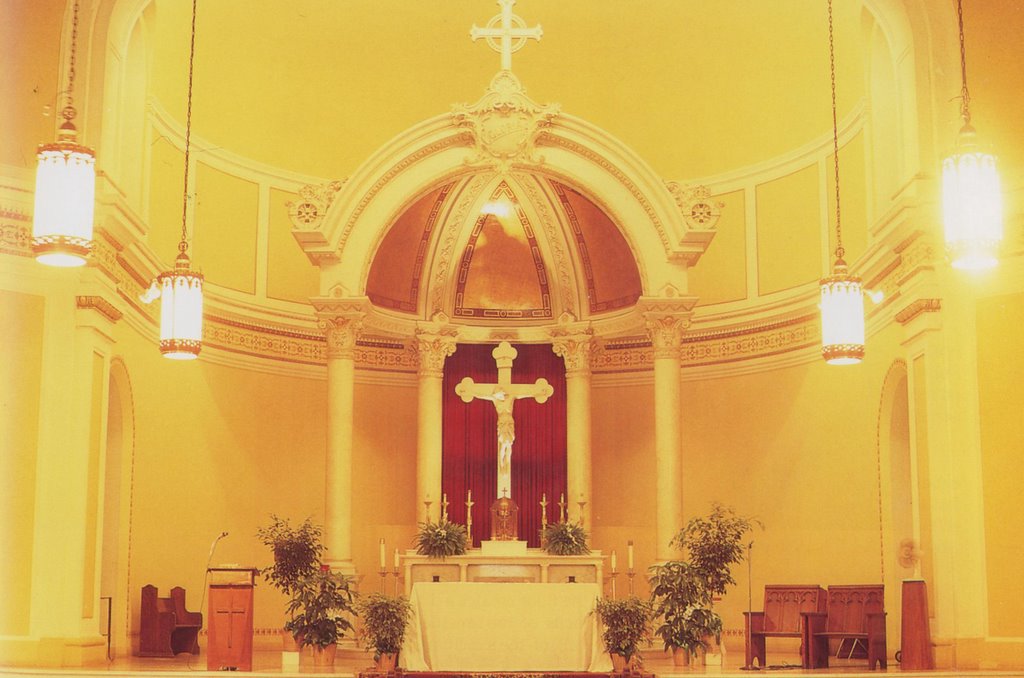
Today there is inoffensive non-representational stenciling behind the side altars and in the sanctuary that I thought was original, or at least very nearly so. However, in This Far by Faith, I found a photograph of the sanctuary as it appeared before a 1955 renovation. Wow. Where that stenciling is now, there were murals (of what subjects, I could not tell). There were beautiful light fixtures hanging in the nave, too. What a pity that they're gone! Even with all the good work that pastor has done in saving the parish and restoring the building, he'll never be able to completely undo the damage done over the years.

UPDATE APRIL 11.

I've found photos of the old Guardian Angels and the old Good Counsel interiors. I've been waiting to post them until I could get over and take new shots of the interiors, but I've just never made it over (no, I don't have a good excuse--I do live in midtown where they are now located). Anways, here I'm posting what I've got.

First, the original sanctuary at Good Counsel before the 1955 rennovations, and second, the sanctuary from an early-1990s photo. Happily, the pastor keeps the ugly modern altar table covered now, and things have been somewhat restored. You can see the high altar in color in the background.

Thursday, December 08, 2005

More on Annunciation Church, KCMO


I first featured Annunciation Church on November 21, 2005. As noted in some of my other updates, the Church of the Annunciation became the home of the consolidated Church of the Risen Christ in 1975, and it was itself shuttered sometime after This Far by Faith was published in 1992.

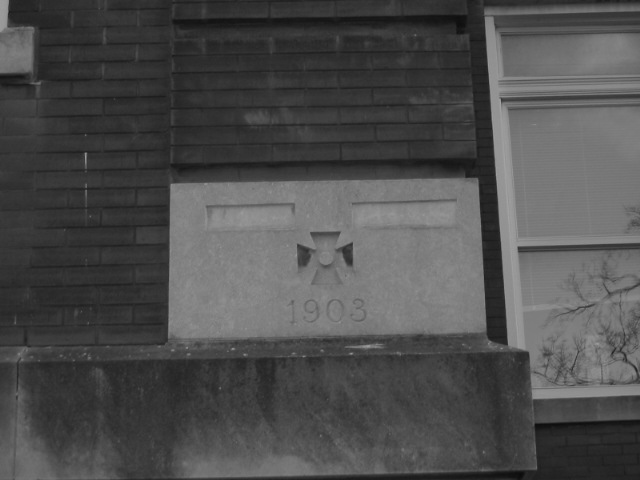
Annunciation was another church that took some time to get going. As you can see from the cornerstone photo in my original post, it was laid in October 1903. However, it wasn't fully completed, furnished and dedicated until 1924. The original cost of building was projected to be $75,000, although (based on the cost of other churches in that era) it undoubtedly cost more to build. The debt from the original construction was paid in 1946.

It was in a Norman Gothic style, and like its sister churches in the area—it was designed to hold about 1,000 people. As was plain from looking at the façade, there were towers for the east and west façade planned but never built. This Far by Faith has a rendering of the church with the towers as planned at page 112. The stained glass (now gone) was made in Innsbruck, and was appraised at $650,000 in the 1980s. The sanctuary featured a baldachino 34' tall and 21' wide. There was a renovation of some sort in the 1940s, and another in the 1975 after the consolidation. More properly, the 1975 work was a demolition: the liturgical vandals wrecked the baldachino and communion rail and replaced the original altar (which, from the description, sounded beautiful) with some sort of table.


On this, the fortieth anniversary of the close of the Second Vatican Council, let's all give a cheer for the aggiornamento and its effects on Kansas City, shall we? A post is coming this weekend on that topic.

Wednesday, December 07, 2005

The Real Lincoln

My post yesterday included a reference to the War Between the States (which, of course, wasn't a civil war, despite its most common designation). An appropriate time to recommend, for a short read, The Real Lincoln by Thomas J. DiLorenzo, which draws heavily from the academic work by David Donald, Lincoln Reconsidered (1961). DiLorenzo's book is pretty good, although it's written for a pretty general audience rather than a particuarly educated set. But it's a nice intro to the Lincoln you didn't learn about in school.

Our Lady of Guadalupe Shrine

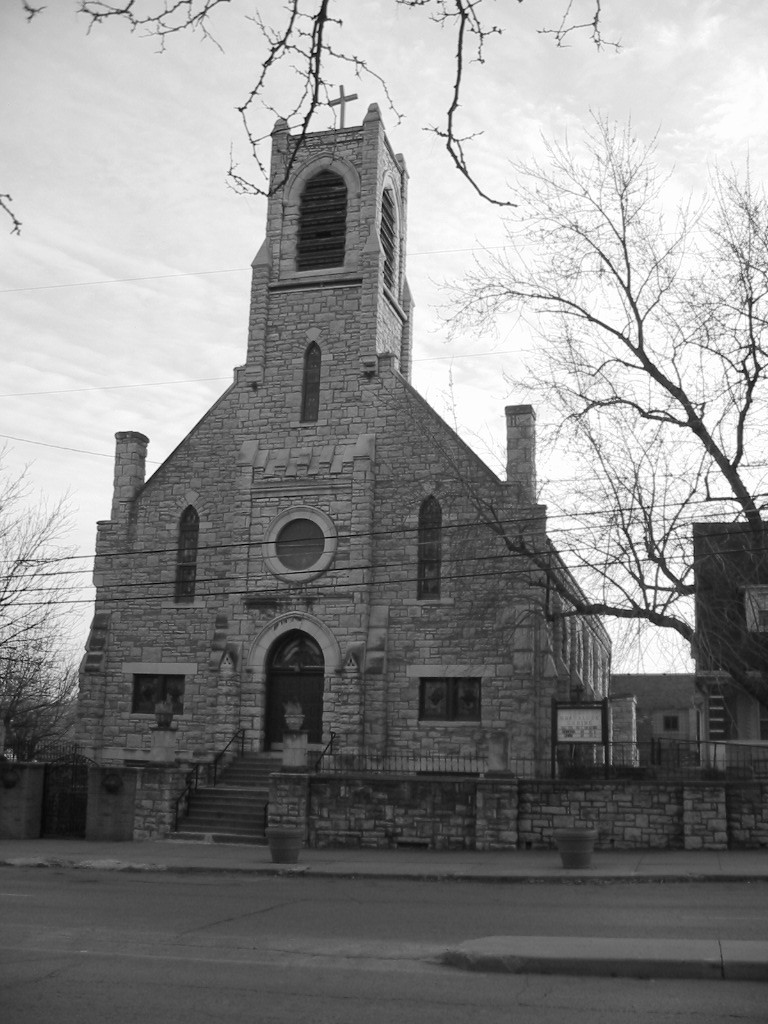
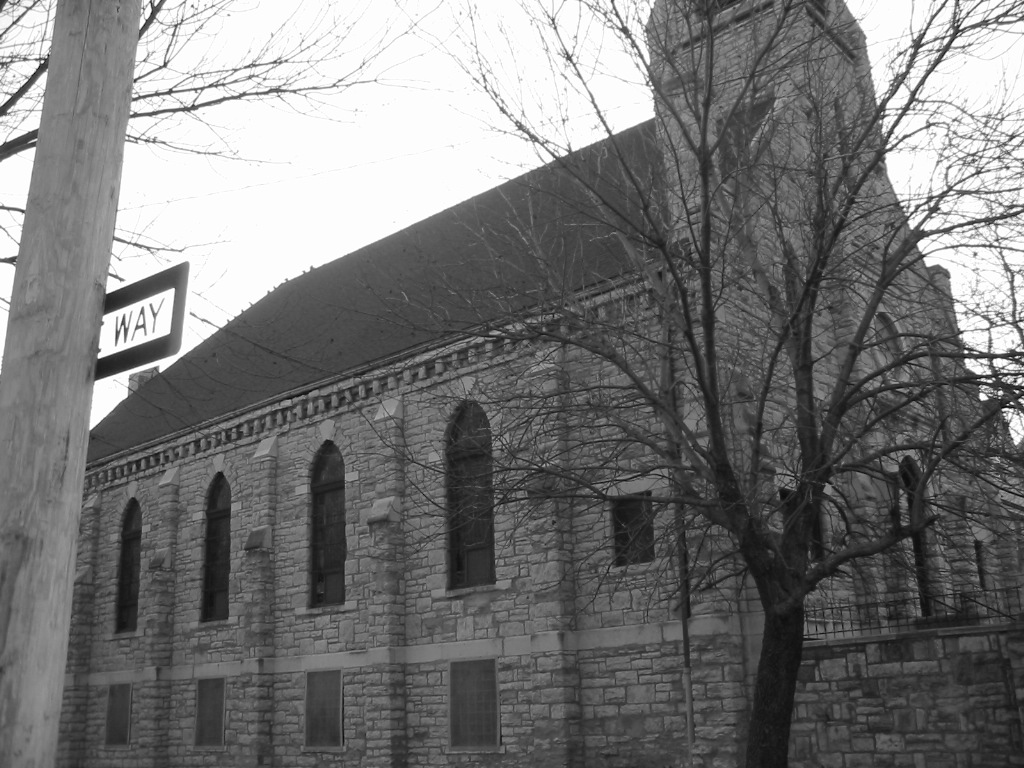
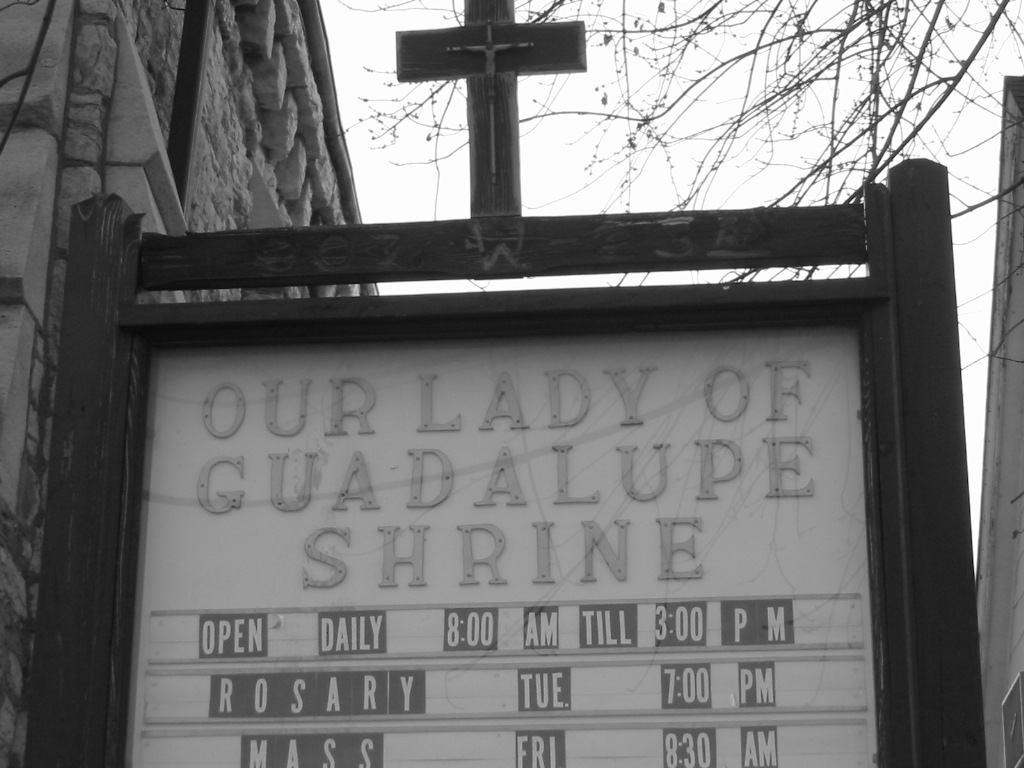
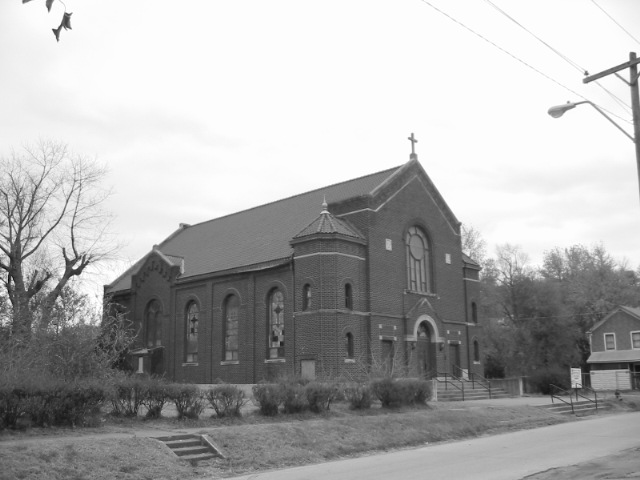
Here's a new church I got some photos of. I haven't done my homework in This Far by Faith yet, but I will. Our Lady of Guadalupe, in Kansas City's westside, was consolidated at some point with Sacred Heart church. The building is now a shrine, featuring one weekday Mass and one scheduled Rosary every week. I've never been inside, and I'm uncertain whether the Blessed Sacrament remains reserved here.

Without knowing more (such as whether this was an ethnic parish), I'd guess this is perhaps another case of overbuilding. The church (which is somewhat smaller than the other closed churches I've featured, appearing to maybe seat 500, from an outside look) is only three or four blocks from Sacred Heart. Why were two churches built so close together? What's the deal? I couldn't find a cornerstone. When was this built? When was it officially suppressed?

At some point, I'll do my homework and fill in details.

UPDATE FEBRUARY 17, 2006

OK, I'm doing my homework: in 1910, the year the Mexican Revolution began (the one that lasted, basically, until 1928 or so, and that featured evil Masonic persecutions of the Church), a colony of refugees began forming on Kansas City's West Side, around 23rd and Madison. Among the poor, hungry immigrants were a few refugee priests who managed to avoid the firing squads. The people of nearby Sacred Heart Parish found out about the priests and got them before the Bishop in order have them granted faculties. As the revolutions and persecutions continued in Mexico, new waves of immigrants arrived, and in 1914 a parish was formed for them and a chapel was erected in a vacant house. Shortly thereafter, the parish moved to a vacant storeroom, and they began to plan and pray (mostly pray, as they didn't have any money to plan with) for a church.

In 1919, the Swedish Evangelical Lutheran Emanuel church building at 23rd and Madison was put up for sale (the Lutheran ministers intended to follow the Swedes, who were moving to the Westport area). The church building and minister's house, which had been built for $100,000 and was listed at $65,000, was eventually purchased for $18,000 through the efforts of Dr. Thomas Purcell, the Sacred Heart parishioner who originally found the priests among the refugees.

Thus, in converse to what we've seen at Holy Name, Blessed Sacrament, Holy Trinity, and St. Francis Seraph, a church built by heretics was eventually taken over for Catholic use. The only changes to the building that were necessary were the removal of Martin Luther's mug from one stained glass window and the addition of an altar (which was donated by the Redemptorists). Other furnishings, and ongoing support, was given surrounding parishes and Catholic organizations.

In 1990, the consolidation of Sacred Heart and Our Lady of Guadalupe was ordered, and while Sacred Heart (which may have been wrecknovated, I'm not sure) was designated to be the site of the consolidated parish. Our Lady of Guadalupe remains open as a shrine.

Tuesday, December 06, 2005

Ah, the smugness of the academic left!

As you Kansas Citians may know, the moron Religious Studies professor at KU, Paul Mirecki, who caused a stink by planning a class (since cancelled) for the purposes of mocking Intelligent Design theories and the Christian worldview in general, went and got himself beat up. Here's the article from the Dec 6 Lawrence Journal-World. Ian at Nobis Quoque Peccatoribus has an analysis of the situation that is, in certain respects, pretty solid. Ian posits that it might have been staged by the clown in an effort to get martyr status among his fellow nihilists. Take a look.

The incident prompted a conversation today between Curmudgeon and a Gray-haired Fellow from Another Department (GFAD) that went something like this:


GFAD: But you saw about that KU professor didn't you?
Curm: Maybe, which one? wha'd'e do?
GFAD: You know that fellow that was going to teach the course on evolution, and sent out all those emails--which he probably shouldn'a done--him. You know. He got beat up the other day.
Curm: Well it just goes to show that not all us Christians are pacifists, eh?
GFAD: It's like America's Taliban, the religious right. There's going to be a civil war, you know!
Curm: Ya think so? About time . . . one suits me. The last one didn't turn out the right way, and that's why the country's in the mess it's in today.
GFAD: What? Well, it's pretty outrageous people beating a guy up over that.
Curm: [missing his opportunity to advocate the rack and the stake] I dunno. I mean,
it's hard to get too upset about that sort of thing. After all, that's how the left has operated at least since the sixties. Guys like that don't have much of a claim to be treated with any sort civility.

GFAD: But beating people up? They don't do that. When?
Curm: Well, I can't think of an example off the top of my head, you caught me off guard. But the left uses force or the threat of it all the time. Abortionists and the NARAL crowd are wrecking pro-life people with frivilous RICO lawsuits and stuff.
GFAD: Well, if they're intimidating people that's fine.
Curm: [missing another opportunity] Well, I don't think it's intimidating the die-hards; they're still protesting. Oh, the you're talking about the protesters, not the abortionists. I think you've got that backwards.
GFAD: Oh boy, we need to talk to you. Who else?
Curm: Well, for instance, do you know why the American Psychological Association declassified homosexuality as a psychological disorder?
GFAD: You're not telling me you think it's a disorder! People are born with it.
Curm: Well, of course it's a disorder, whether people are born with it or not. People are born with all kinds of weaknesses and disordered inclinations. I know I've got my share--although I don't struggle with same sex attraction, of course. I hope you don't buy into that Kinsey 10% garbage. It's not based on scientific method. Which brings me to my point. The APA dropped homosexuality from the DSM not because it had any scientific reason to, but because militant homosexual activists hounded them through the late 1960s (and the 1970s, I think), harrassing the people in charge of the DSM, disrupting their classes, their practices, and their speeches. The APA was bullied into dropping it for political reasons, not science.
GFAD: [signalling retreat] You really think that? Wow. We have to talk to you.
And so it ended, without my getting to use some of the best lines I keep in my pocket: "I don't let the NPR people do my thinking--or my feeling--for me" and "Well, considering the rate at which people like me are breeding and the rate at which people like you are contracepting and aborting, my views will soon prevail based on demographics alone, right or wrong."

It's so much fun (and I've relayed this in a previous post, I think) to just play along with these guys and to treat their views with the same skepticism they treat yours. It really takes them by surprise when they come across younger, similarly educated people in the same line of work as them who don't subscribe to the conventional wisdom. Once you go into a detailed defense of your views in these water-cooler conversations, you lose. You can almost hear the NPR Morning Edition fanfare (Dah-dah-dah-dah . . . Dah-dah-dah-dah) as they write you off and their minds shift to the next little 2-minute artfully produced water-cooler vignette about the goofball art they've installed across from Barney Allis Plaza in KC (much like the serious review of a new album by some clown playing an underwater digital saxophone you'd here on NPR). BUT, if you start questioning their views, pretending that yours are the conventional wisdom (easy to do if you don't watch TV and or follow current events very closely), they usually don't know what to say.

I once had a conversation with another gray-hair from another department, this time at an Indian restaurant buffet in Johnson County, in which I said the only person I personally knew in the legislature was Kansas Senator Kay O'Connor. The GFAD said, "Oh, you must be a conservative Republican," to which I responded that I hadn't voted for a Republican presidential candidate since George Bush #1 in 1992 (which I regretted), and that I wasn't a conservative. When he challenged me on whether I was a conservative, I said I was a reactionary, not a conservative, because I didn't see anything in the political or cultural status quo worth conserving. The fellow almost dropped his plate of curried chicken, laughed nervously, and started talking about a business client of his.

So my thought is that (with minor adaptations for persons and circumstances) that we all quit engaging the progressive/liberal/radical Jacobins in our midst in any substantive way, and we do what our parents did to us when we were 13 or 14 years old and started repeating some of the political and cultural nonsense we picked up in junior high school. We, in a tone of feigned naivete, ask things like "What on earth do you mean?" and "Where did you come up with that idea?" and put them on defense. If my fellow evil trads need advice on this, I'd suggest they go up north and take lessons from Hilary, who would seem to manage the technique well.

Only in rare circumstances are you likely to get caught with someone who can trace their views pack to Jeremy Bentham or Jean-Jacques Rousseau or whatever particular high-on-cocaine-snuff enlightenment theorist that first expounded them, or someone who can go on-and-on about John Dewey's principles of pragmatism. Usually, the best authority they can come up with is "it's obvious" or "they say" or something they heard on NPR or read in a New York Times Book Review or a Molly Ivins column.

Really, in situations like this, where you're having a couple of minutes of casual conversation with someone, they're not going to actually listen to and remember your views, even if you're more prepared than I usually am to expound them concisely. Whatever you say, they file it under "right wing crank." So why not turn the tables on them? It may be more effective to impress upon them the fact that the opposite view can be held just as smugly and certainly as their own, by someone so sure of its rectitude that he feels no need to defend it and is shocked that anyone could hold the conventional view. THAT might actually get them thinking.

Does any of this make sense?

Sunday, December 04, 2005

The Week's Catholic Key

I received my Catholic Key for December 2, 2005 on Friday. Wouldn't you know it, a diocesan newspaper "buries" big news from the Vatican, the new instruction on homosexuality in seminary applicants, on pages 12-14. Front page is a picture of hungry heathen children and an article on "Catholic" Relief Services work in Pakistan following their earthquake. Naturally, the article is on the response of "nongovernmental" organizations, begging government funding.

Hey folks, if it's tax money you're asking for and spending, it was taken by force or the threat of force, not given. In that case, you may be doing "social justice," but YOU AIN'T DOIN' CHRISTIAN CHARITY!!!

Ahem, I've said it before. I'm sure I'll say it again. The Key still stinks. Other articles include:
  • Maryknollers (the lefty nuns who've, of course, kicked the habit) still mourning the death of their sisters who were murdered (presumably while meddling and peddling for the Sandinistas) in El Salvador in 1980.
  • Two more articles on "Catholic" Relief Services work in Pakistan.
  • An article mourning the fact that health care hasn't been federalized 60 years after Truman first proposed that Big-Brother take it over.
  • Two articles against the death penalty, one of which is by some clown trying to confuse people with "Pro-life must include protecting poor, opposing war,"
  • An articles on antiwar protests at Ft. Benning,
  • The usual movie reviews from the USCCB film office. Naturally, the film version of Rent, was not rated "O-morally offensive." It was rated "limited adult audience," and Bernadin's boys on the USCCB staff buried any sodomy judgment in a subjective clause in the middle of the review: "while the dissolute lifestyles of some of the characters take second place to the overriding themes of love, connection and fellowship."
  • The bishop's column on stem cell research.

In other Key news, it was relayed to me by a friend of a friend that Albert deZutter, the editor, complained in a published interview with an academic journalist studying the Catholic diocesan press that his publisher, Bishop Finn, is somehow censoring him, because he reviews deZutter's editorials before they run and corrects them to conform to Catholic teaching (and deZutter is apparently refusing to run the corrected editorials). (If you can point me to that published interview, please do). It's obvious that a publisher's control of the contents of his own publication isn't "censorship," of course, but claiming that it is censorship is effective, because so many people are too stupid to see that.

The friend-of-a-friend posed for a luncheon discussion, the questions "why is deZutter doing this?", and "why is Finn tolerating it?" There are several possible answers for the first point--mine is simply that deZutter's a dissident doing the devil's work. My theory is that he's holding out with Finn until he finally gets fired, which will impress Satan's little helpers in the "progressive Catholic" press, and help him get his next job. It's as good as any other. The second question, "why is Finn tolerating it?", is a tougher one. I don't know. The Bishop's done a number of things right--replacing the key chancery staff, holding the Corpus Christi procession, ditching McBrien, unplugging the "New WHine" program. Why won't he take decisive action here? Maybe he has something bigger up his sleeve, like abolishing the Key entirely, in which case it doesn't make sense to replace the editor right now.

A world without the Catholic Key? Wouldn't that be great?

Saturday, December 03, 2005

Source on my closed church "project."

I found a source for information on closed churches. The Kansas City Public Library has This Far by Faith, a two volume book on the Diocese of Kansas City, St. Joseph, the second volume of which is a compilation of parish histories. Unfortunately, they've only got one copy and it doesn't circulate, so I'll have to find some time to spend there. Hopefully, I'll be able to go back to the parish churches I've already featured and get some details, as well as perhaps identify some additional churches that have been supressed, demolished, etc.

Wednesday, November 30, 2005

Franco book

A reader of my post last week seeking recommendations on a Franco book reports that he knows of no fair-to-sympathetic books on Franco, but he recommends Warren Carroll's The Last Crusade: Spain 1936. That goes on my list: wish I had some birthday money left, as I spend the last of it on two Belloc books.

Monday, November 28, 2005

John Paul the Great

I read the phrase again somewhere, for the first time in a several weeks.

The more I read about St. Leo the Great, who, as a temporal ruler turned back Attila the Hun and as the visible head of the Church put down Monophysites and Manicheans that would have destroyed her, and St. Gregory the Great, who as a temporal ruler pulled Rome out of the Dark Ages and as visible head of the Church furthered the Roman rite of Mass and codified the music that would sustain her for more than a millenium, the more I wonder about those who talk about John Paul the Great. I hear the appellation less and less, but I do occasionally hear it.
To love and respect JP2 is admirable--he was, after all, the Vicar of Christ. But c'mon, he's not in the same class as Leo or Gregory, is he? I've always heard that a cleric must teach, sanctify and govern. I think more and more people are sobering up and coming to the realization that (although they may believe he did two-thirds of his job very well--which even some will credibly argue otherwise), he wasn't much of a governor. He didn't show much firmness in leading the Church, and in the area that most mattered--the appointment and "promotion" of bishops--his record is frankly rather poor. For every great bishop he gave us, we can name one or more that has done great harm to the Church.

JP2 was a holy man, but one with a mixed record. Let's pray for him and petition him to pray for us, but let's give up on the "Great" appellation, shall we?

Sunday, November 27, 2005

St. John Fisher

I just finished reading E.E. Reynolds' biography of St. John Cardinal Fisher, Bishop of Rochester. I've always loved St. John Fisher. In reading Reynolds' biography, though, I'm struck not only by the blessed martyr's faith and constancy, so much as I am by the perfidity, cowardice, and malice of the various reprehensible apostates that surrounded him.

It's a part of choleric personality that's hard to overcome, I know, but it's so difficult for me to pray that God had mercy on those men, because the case for His justice is so strong. And it's hard not to further harden my contempt for the modern day Anglican "hierarchy" If they insist on continuing to destroy their own sect and lead their adherents to hell, why dont they just get on with it, and quit lingering!!! Which is, of course, all the more reason to force myself to pray for them.

There's an interesting article in this number of Latin Mass on the choleric personality, the second in a four-part series on temperaments written by Fr. Christian Kappes of Indianapolis. Worth reading (and here I remind myself that my Latin Mass subscription is up for renewal . . . . .

Saturday, November 26, 2005

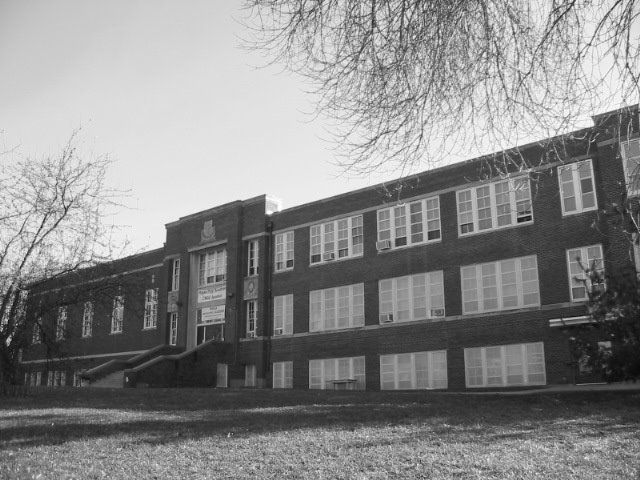
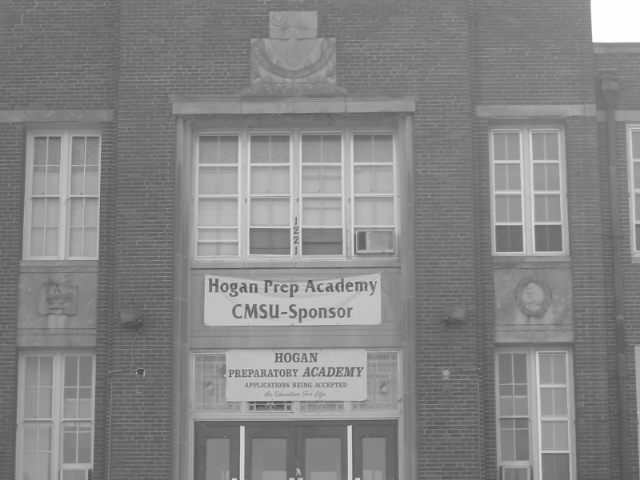
Bishop Hogan High School


When I was at the Convent of the Benedictines of Perpetual Adoration the other day, I took a couple of pictures of Bishop Hogan High School, now "Hogan Academy," a charter school sponsored by Central Missouri State University. It wasn't long ago that Hogan closed. I have an aquaintance whose daughter went there and reported that it wasn't particularly Catholic. Funny thing, people don't wanna spend several thousand a year on a mediocre, nominally Catholic education. A pity.

Two problems with Hogan--obviously the Catholicity and orthodoxy problem at diocesan schools as a whole, which I think Bishop Finn will address, insofar as one man can, over time (but, I suspect, not quickly or definitively enough for my kids to benefit). The other is the cost problem. Without dedicated religious teachers and decent endowments, Catholic education (of any quality) at the secondary level is really out of the reach of Catholic parents. All but the most prosperous big Catholic families (the ideal Catholic families) could never send five or six kids through high school at six or seven grand apiece, could they? Lots of catholic elementary schools have a sliding scale for multiple children (one that I know of charges a flat rate for four or more), but I don't know how the high schools respond.

Friday, November 25, 2005

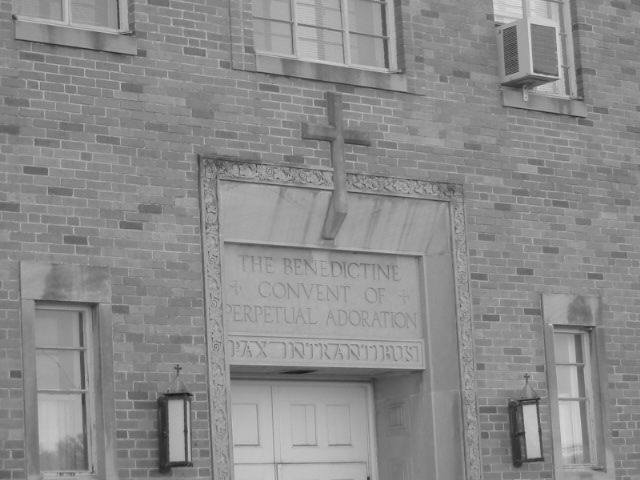
Benedictine Convent of Perpetual Adoration, Kansas City, Missouri

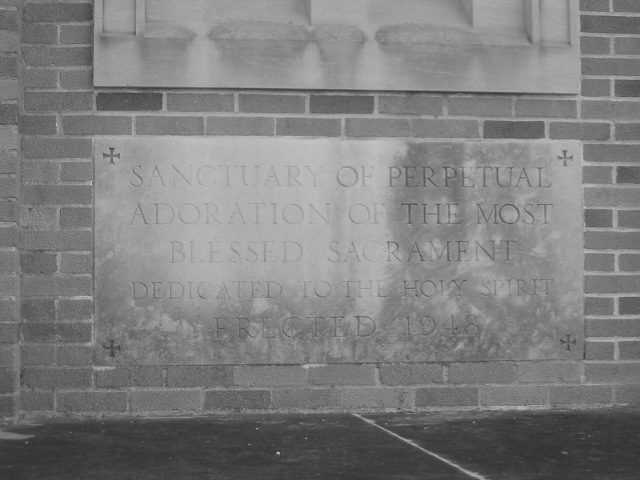
Dedicated in 1948, the convent of the Benedictine Sisters of Perpetual Adoration was purchased by the Society of St. Pius X and now houses the Franciscan Sisters associated with the SSPX. The huge edifice (in the well-balanced but unornate style of those few mid-twentieth century architects who hadn't lost their heads yet) at 63rd & Meyer is a testament to "moribund" and stale preconciliar Catholicism (as George Sim Johnston put it in the article that caused me to cancel my subscription to Crisis magazine), and that fact that it was emptied and abandoned by the order a decade or two ago is likewise a testament to the "new Springtime" we've been experiencing since 1964, isn't it? My understanding is that the sisters have a lot of infrastructure work to do--significant plumping upgrades. Click here for an article on the state of the building (SSPX newsletter, in PDF format).

Whatever you may think of the SSPX situation, let's all pray that they can keep the structure up on their own until there's a traditionalist reconciliation, the Catholic world starts to right itself, and they can get a wider base of support.

I recall a few years ago a little dispute between the owners of the old Bishop Hogan High School (now some sort of secular charter school, which I also took pictures of) and the sisters arose when it was discovered the football field was built halfway on the convent grounds, and halfway on the high school grounds. The sisters wanted protection from liability and rent payments to help them with their own expenses (a reasonable request, given that a secular high school football program isn't part of their apostolate, if you ask me). I'm not sure how that worked out.

I've also heard a rumor that someday the sisters hope to open a girls' school at the convent. That sounds appealing, especially if an SSPX reconciliation can be worked out. As it stands, I wouldn't send my girl to either of the "Catholic" girls schools in town. I haven't heard anything good at all about either of them.

Feel free to add other details. For instance, do you know when the Convent folded? Did any of the Benedictine sisters have any attachment to or involvement in Bishop Hogan High School, or were they all strictly contemplative?

UPDATE FEBRUARY 17, 2006.

One again, nobody's volunteered to do the research for me, so I took care of it. I imagined at one point that this would be an interactive tour--I'd just drive around town with my camera asking stupid questions in my post, and other people would run off to their libraries or rectories and do all the research for me. That's happened in a few cases, but sadly, it hasn't happened enough. It's starting to feel like work or something. Anyways, I'm not at page 507 in This Far by Faith.

The convent was founded by the Benedictine Sisters of Perpetual Adoration at Clyde at the invitation of Bishop O'Hara in 1943. Construction began in 1947, and the sanctuary was dedicated in 1949.

The practice of Adoration was supported widely (to hear the historian tell it), and laity across the city participated in it, with regular holy hours, benedictions and processions. However, by 1982, the sisters at Clyde elected to close the convent due to a lack of vocations and increasing costs. The property was sold to an evangelical group of heretics, Youth for Christ, in 1984 for $750,000. As noted above, it was recently purchased by the Society of St. Pius X for the use of Franciscan sisters (third orders, technically, due to jurisdiction issues that will, we pray, soon be worked out), and they're raising money to do necessary major plumbing and mechanical work to the facility.

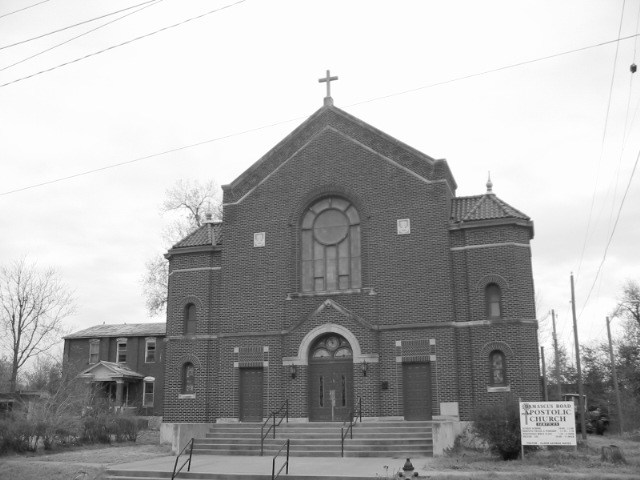
BTW, if you're in Kansas City, and you've never driven up near Maryville to see the Benedictine Convent at Clyde and Conception Abbey, and the Benedictine convent at Clyde only a mile away, it's a great way to spend a Sunday afternoon this spring. The outside views are something. I can't evaluate the orthodoxy of either the Clyde nuns or the Conception monks at Conception (except to note that the nuns have kicked the habit and the monks have wrecknovated their bascilica, though they preserved the interesting original Beuronese murals). The chapel at Clyde is beautiful and mostly intact and the nuns had one of the largest collections of relics in the United States at one time. If you go, you might call to see if they still have them, and when and how they can be viewed.
Thursday, November 24, 2005

Loretto Academy, Kansas City, Missouri


Family obligations have prevented me from continuing my exploring or doing further research into closed Kansas City, Missouri Catholic churches, so I'll stray a little from my main theme and feature the Loretto, formerly the Loretto Academy, a big structure built in 1903 to house the girls' school run by the Sisters of Loretto. In its day, it was one of the places to send your girls to school. It was (I read in a Kansas City Star article last year or so) also point of contention when integration came shortly after World War II (the Bishop, I read, forbade any Catholic parochial school to accept girls transferring from Loretto because of the integration).

I'm not exactly sure when the Loretto closed. Kind readers please inform me. When I moved to Kansas City in the mid-1990s, I believe the building had been purchased by some evangelical sect, which was using the building as an independent Bible college. At some point, it was rehabilitated, and now it's the home of some neighborhood non-profit association and it also has loft apartments. One can rent out rooms for meetings, I think, and one can rent out the chapel for weddings and commitment ceremonies and such things. At some point, I need to call over and get the story. As for the Sisters of Loretto themselves...a quick google search will confirm that they've gone off the deep end. Sometimes when I drive by I think of the Loretto convent/hospital/school and chapel in Santa Fe, started by sisters recruited by the saintly proto-bishop of Santa Fe, Jean-Baptiste Lamy (fictionalized as Archbishop LaTour in Willa Cather's Death Comes for the Archbishop). That Loretto has been turned into a hotel, where we sometimes stayed when we vacationed in New Mexico as a kid. The chapel was a tiny gothic thing with a "miraculous staircase" to the choir loft built by an unknown carpenter (piously believed to be St. Joseph, I think). It was a spiral staircase built with no central support.

But back to THIS building: The style is pretty classical--lots of dentil moulding and a nifty oxidized copper cupola top this red-brick symmetrical building. The cornerstone has been defaced (it must have made reference to the Blessed Mother (offending the evangelical sect) or to the Deity (offending everyone else in this heathen part of town). However, carved in wood relief over the main entrance are the words FIDES MORES CULTURA; those didn't get defaced by anyone (thank God for those sticky preservation requirements attached to historic tax credits). The chapel is substantial, you can see it as the center wing extending south, behind the main building (which faces north).

Although not a church, the Loretto campus is another example of what wiser men describe as the devastated vineyard in the aftermath of the Second Vatican Council. When I daydream of the renaissance, I imagine it as a seminary (it goes like this: the FSSP or the reconciled SSPX have so expanded their seminaries that they break off the theology programs from Denton or Winona and establish it at the Loretto). The other crazy daydream is that I win a really big powerball jackpot, buy the building, start my school, and operate my Evil Traditionalist empire from the Loretto campus, much to the chagrin of those pursuing "alternate lifestyles" or living the wine-and-cheese liberal life around town.

Updated February 17, 2006

The girl's school was founded 1901 at 36th and Broadway in a private home, but the sisters (who were more like the heroic Sisters of Loretto that assisted Abp. Lamy in founding Santa Fe than the Sisters of Loretto we have these days) didn't waste any time: they bought the land at 39th & Roanoke in 1902, laid the cornerstone in 1903, dedicated in 1904. The school thrived for a long time, but in 1964, the school moved way out to 12411 Wornall, and the grand original school was sold to Calvary Baptist College in 1966. In 1989, the facility was transformed into a retirement home of some sort, and the chapel is rented out for weddings.

Although our concern is with the building, we follow the school out south to note that boys were admitted beginning in 1970, and by 1984, the school had petered out. The board voted not to reopen for the fall of 1984.

Reviewing the Baltimore Book of Prayers

In reviewing the Baltimore Book of Prayers, following the rite for the Churching of Women. I came across the prayer of thanksgiving after childbirth. Even though I haven't given birth to any children, nor will I, here goes:

Gracious God,by whose providence we are made, who formest us in secret, who beholdest us when we are yet imperfect, and in whose book all shall be written: I humbly beseech Thee to accept this my acknowledgement of Thy power, and to receive this my most hearty praise and thanksgiving, which I now offer to They divine Majesty, for They favor and goodness towards me. Behold, O Lord, what Thine own hands have fashioned; and grant that this infant, which Thou hast made by Thy Power, may be preserved by Thy goodness, and, through the grace of Thy Holy Baptism, may be made a living member of They Church and be carefully brought up to serve Thee in all piety and honesty. Through the merits of Thy dearly beloved Son, Jesus Christ our Lord. Amen.

Wednesday, November 23, 2005

Searches for Churches: I need your help, Kansas City!

The remaining closed churches that I plan to visit sometime this weekend include the following:
  • Benedictine Convent on 63rd Street (now owned by Franciscan sisters associated with the SSPX),
  • Our Lady of Guadalupe (suppressed as a parish, but operating as a shrine), and
  • The Loretto Academy (not a church, but a girls school and a convent that collapsed simultaneously with parishes in the malaise of the last 40 years)
I may try to find a couple of the more elusive church buildings that the lady down the street from St. Francis Seraph suggested, but I would really like some input from the handful of Kansas City readers, as well. What other suggestions to you have within the Diocese of Kansas City-St. Joseph? There are a couple of Kansas churches I plan to visit, but I want to try to round out the Missouri side before I cross the state line.

Tuesday, November 22, 2005

Homosexuals in the Seminaries

Even before I read the document, I knew it had to be a generally positive one. At a reported five pages or so, there couldn't be too much "nuancing" going on in so short an instruction. Really, though, there seems to me to be a pretty big loophole in the requirement that a seminarian with disordered inclinations live in chastity and perseverence for three years before diaconate ordination. Is that time frame meaningful (especially considering that diaconate ordination typically occurs in the sixth year, or so, of seminary, which is by my math three years AFTER admission to the seminary). So does that mean that a seminarian who committed an indiscretion of this sort while actually in the seminary might get an official free pass? Do we really want priests who act out in any sort of sexual way while they're in seminary? I'm sure I'm overlooking something; please explain.

Even so, it's unrealistic to think anything will change in the West--bishops and seminary rectors who are so inclined will provide their own nuances to the document. The Wuerl/Mahoney crowd will have to study it, and to implement it over time and with "prayerful reflection on the pastoral needs of their local Church" or somesuch garbage. It seems likely that the solid seminaries will remain solid, and for years to come, the pink seminaries (that remain open) will remain, more or less, pink.

What we can hope for is the cultural reallignment of nominal Catholics to pick up some steam. Maybe self-righteous liberals like Cuomo and the Commonweal crowd will give up their pretense of Catholicism and join the Episcopalians. Maybe houses upon houses of corrupted Jesuits and Sisters o' Mercy will discover a way to live their vocation within structure (that remains) of the Anglican schism. That reallignment will leave a little more room for us bigoted, medieval Catholics in the pews as we continue to breed, and it will perhaps remove a few layers of the lay liberal insulation surrounding the Wuerl/Mahoney crowd. Any additional harm to the souls who are leaving aside, such a reallignment would be good for the Church Militant in the West, as the body that remains will be stronger, more unified, and more capable of doing meaningful battle in the war against the "synthesis of heresies" that is Modernism.

Monday, November 21, 2005

Annunciation Church, Kansas City, Missouri

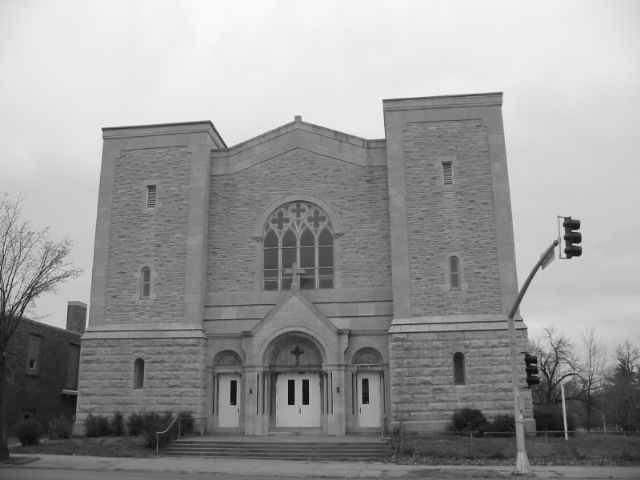
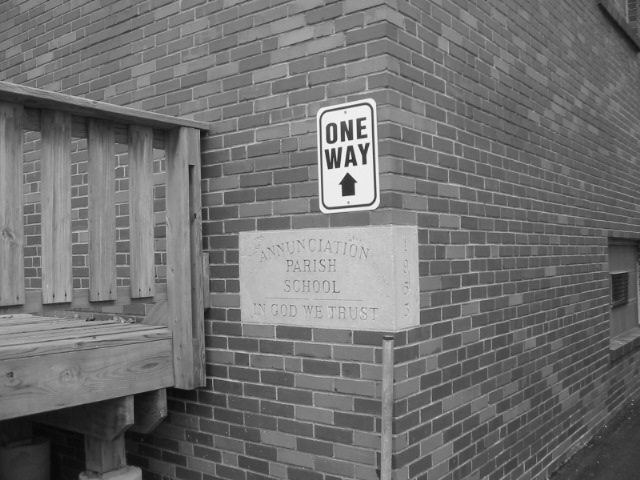
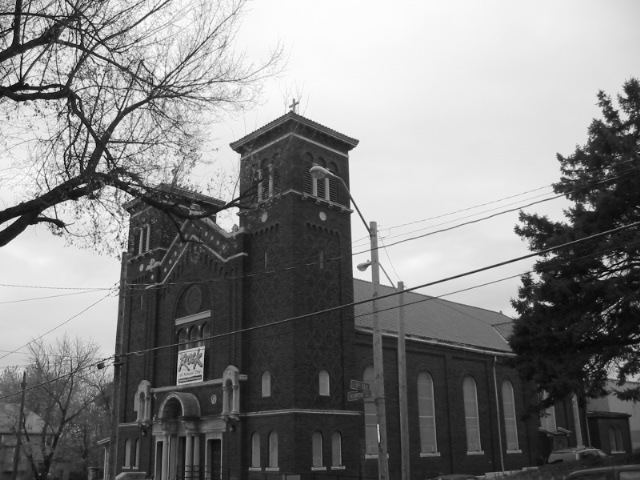
The reader who tipped me off to St. Francis Seraph also suggested I drive by Annunciation Church at 31st and Benton. This church, dedicatd in October 1903, isn't a large one by height (as with Holy Name) or length (as with St. Vincents) but it appears to have a large, wide nave and very big transcrepts.
Obviously, towers were planned (or at least allowed for). The stained glass is gone, but I couldn't see inside. I had to jump a small chain link fence and pull away the weeks to get a shot of the cornerstone, which reads as follows:

(Alpha Chi-Rho Omega)
DEO
TRINC ET UNO
Ut BVM de ANNUNCIATIONE
Culiel Sacero
FECIT
Operis Faciendi Laridem Aussilialem
Rite Ditatum Manu
IN JESU
Pontifex Joanus
10 Octob AD MCMIII


(My Latin is so limited, that I'm not going to embarrass myself by attempting a translation).

I'm told that this church was (in the first round of closings) the surviving church for the merged parishes of Annunciation, Holy Name and St. Vincent's, and that it was subsequently closed itself in the mid-1990s. I don't know whether the merged parish was "Annunciation" or if it was rededicated as something else.

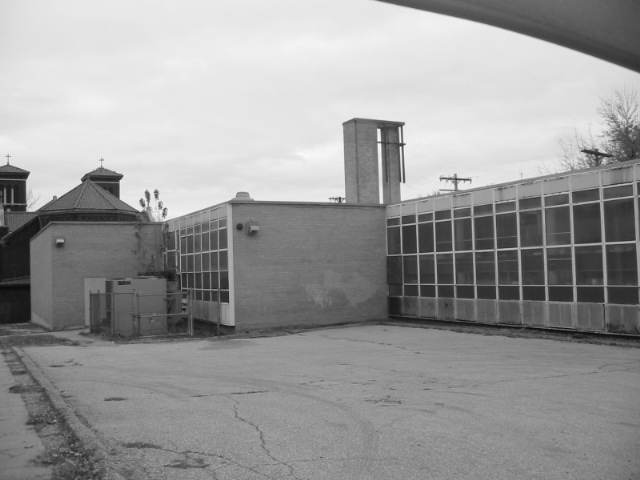
Obviously, though currently vacant, the building has been in recent use (i.e., in the last decade, given that there is air conditioning equipment jutting out here and there (and marring the lines of the building). Does anyone have any information that's more specific than this? I've also attached the cornerstone of the parish school, which is of much more recent construction--1960s or 1970s. It appears the school me still be in use for some purpose.
Please share details if you have them!

UPDATE FEBRUARY 17, 2006.

Well, nobody shared any details, so I had to do my own research again. Annunciation was created out of St. John Francis Regis parish on May 25, 1872. At its founding, it was the third parish in Kansas City. After meeting in an empty store at 12th and Wyoming for a few months, a frame church was built (in 7 days!) at 14th and Wyoming. In 1880 they built a brick church adjacent to it at a cost of $40,000. In 1898, the facilities at 14th and Wyoming were bought by the railroad, and the parish was reestablished in what was then the countryside. The boundaries were 27th Street to the north and Brooklyn to the West, with no southern or eastern boundaries. Ground was broken on the new church in November 1902, and construction on what was to be a $75,000 church began in earnest in 1903, but work was intermittent due to money shortages. It it wasn't dedicated until in 1924, and the debt wasn't paid until 1946. The original plan for the church did, in fact, include towers that were never built, as I surmised back in November. Below you can see a rendering of what the church might have looked like if fully executed.

The stained glass windows (now removed) were made in Austria and installed in 1924. A magnificent altar (donated by Jim Pendergast) and baldachino (designed by Deprato Service and Rigalicograced the church, which was still open at the time This Far by Faith, vol II was published. Here's the description of the baldachino, at pages 111-12:
An extraordinary feature of the church was the baldacchino. It was basically a dome ofver the altar supported on four pillars. It is described as follows: "The baldachono propert is 34 feet in height to the top of its high-flung Cross; the width over all is 21 feet. There are four massive columns of Paonazza Scagliola mounted upon bases of Italian marble made resplendent with panels in Breccia Rossa. These handsome Scagliola monoliths support a richly ornamental cornice upon which rests the canopy artistically executed in conformity with the architectural style of the church. A beautiful ceiling of gold and colored mosaic, pure oriental in type, is seen from below.
My sources tell me that the altar and baldachino are still in place and intact, which is delightful news, considering the awful things that happened to the interiors of other churches nearby (i.e., Holy Trinity). I have to guess that the liturgical vandals from the Helmsing/Sullivan era couldn't raise enough money in the poor parish to wreck it and haul off all that marble.

In 1975, Annunciation, Holy Name, and St. Vincent merged. The Annunciation parish plant was the site of the new Church of the Risen Christ. The Church of the Risen Christ featured such events as "'Stations," [] a liturgica drama characterized by dance, dialogue and music as the congregation moves in reflection on the traditional 14 movements of the Station of the Cross," a theatre company, and an anniversary celebration in 1979 featuring preaching by Rev Emmanuel Cleaver (yes, that's the heretical minister who's now, unfortunately, our Congressman, not a Catholic priest). The Spirit of Vatican II couldn't sustain the parish, however, and sometime in the 1990s, the parish was supressed and the remnant in the pew was packed off to yet another church.

Franco

Over at De Civitate Dei, Rick Lugari has posted a nice tribute to General Franco. I'm not much up on 20th Century Spanish politics, but maybe I'll look into it. I've always had a soft spot in my heart for Franco, but didn't know enough about him to really feel comfortable publicizing my non-PC affinity for the Generalissimo and using it to offend people. Maybe I'll take the time to study up on him. I can't count the number of people who'd go nuts if I put a portriate of Franco in my office. Oh what fun!

What's a good, well written book about Franco--written (in English) for the average educated reader?

Sunday, November 20, 2005

Holy Trinity, Kansas City, Missouri

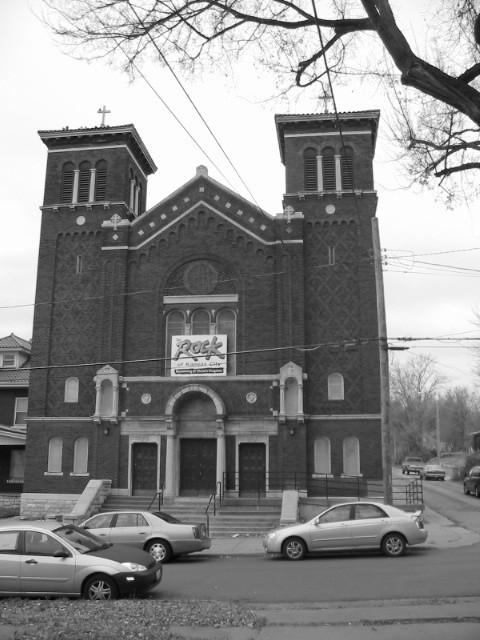
In the Lykins Neighborhood east of downtown (at East 9th Terrace and Norton) sits The Rock of Kansas City: Reclaiming Christ's Kingdom, formerly known as Holy Trinity Church. I found and photographed this church at the suggestion of the anonymous woman I spoke to down the street from St. Francis Seraph. This is one of three churches she told me about, but the only one I could find.

I was able to peek inside this one (there was a wedding rehearsal going on), but I wished I hadn't. As you may be able to tell from the picture above, the windows are covered in steel grating. The inside is a cheaply sheetrocked and carpeted box, with no fixed seating, no sanctuary, no natural light (from the peek in from the front door that I made) and no indication that this is a church of any kind, much less a pre-conciliar Catholic church. Behind the church is the old parish school, which, judging from the architecture, was thrown up for bottom dollar in the late 1950s or 1960s.

Other than the fact that this parish was merged into Queen of Peace (a fact that is unconfirmed) I know nothing of this church. So I ask again, When did it close? Any special reason why (or just the combination of shifting demographics and failed leadership in maintaining vocations and evangelizing the newcomers)? It seems to me that the neighborhood is mostly Hispanic. What does that say than a Catholic church can't be kept open in an Hispanic neighborhood? So much for a big-budget "Hispanic ministry." Any special history here?

This is yet another church I've posted that was built in the 1920s. What do people know about that era in Kansas City? Why were so many churches built in that time? Why are they all closed now? Please chime in!

UPDATE FEBRUARY 16, 2006

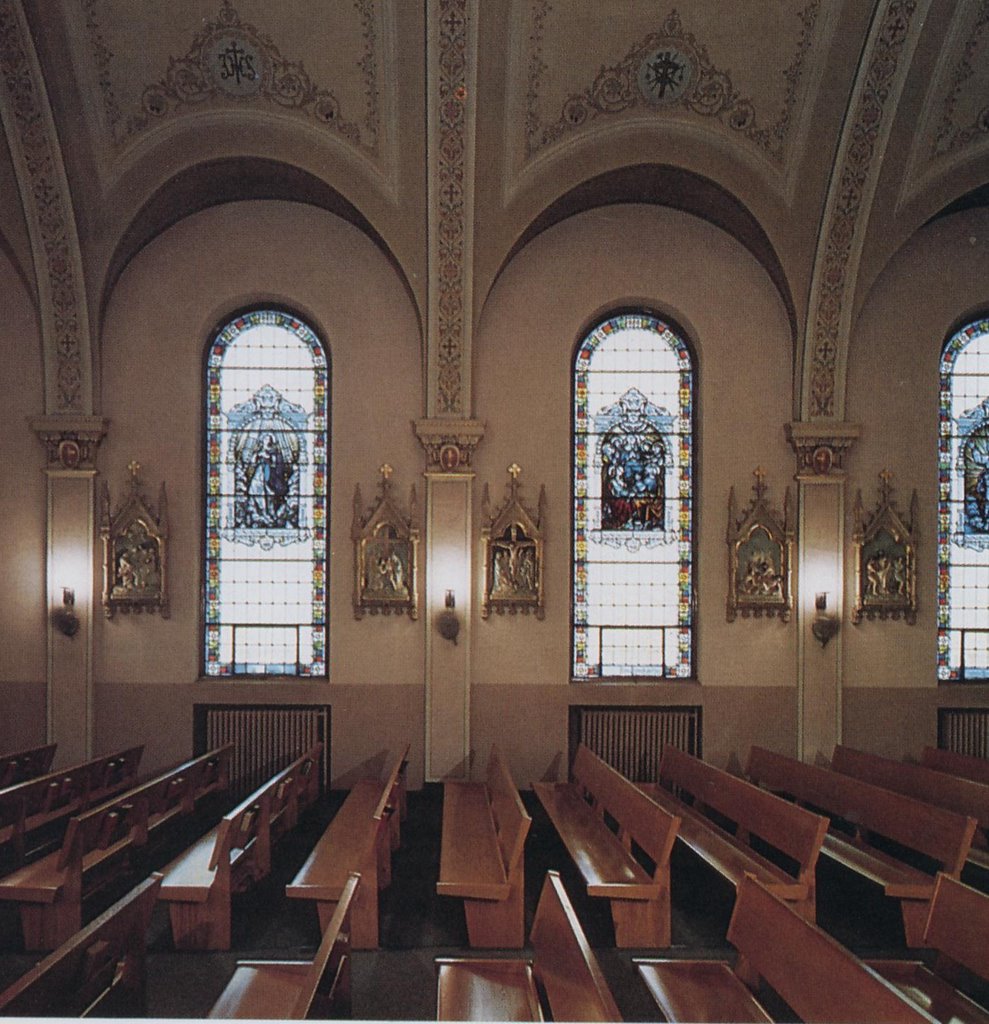
Armed with This Far by Faith, I wade back into the subject of Holy Trinity. Enclosed is a fine photograph, taken by Dorothy Marra, of one of the better bits of the interior as it was shortly before it closed. You can see the fine stencilling by Dante Cosentino, the stained glass, and stations of the Cross in this shot (I make no comment on the pews, which are not original). Mrs. Marra spent a lot of time photographing this church, and there are details of windows and other features in the color plates of volume 1.

Holy Trinity parish was founded in 1889, and the original church at 7th and Cyrpress burned down twice. In August 1925 ground was broken for the present church, and in August 1926, the church was completed, at a cost of over $90,000.

The balance and harmony of the interior was, in the words of Bishop Lillis, "heaven." Two Carrara marble statues stood in the facade alcoves (now obscured by "The Rock's" sign), and the high altar was "frescoed in ivory and gold with numerous spires, was set in a canctuary apse which was painted and decorated in purple, green and gold. The rest of the description sounds, well, like something that couldn't afford to be built by the wealthier congregations these days, much less a parish with no more than 175 families at the time of construction, none of which were wealthy. Those 175 families managed to pay off the construction debt within seven years of completion. A great tribute should be paid to pastor Monsignor James Joseph Keegan, pastor from 1918 through 1958 for seeing a humble parish in an unremarkable part of town grow and prosper. Msgr. Keegan died in 1964. God is merciful for calling him home before he could see what was about to happen . . . . . . .

......What was about to happen? I can't paraphrase what happened without doing an injustice to the official historian; I shall have to quote the book directly, on page 170 of Volume II:

In the 1960s, after the liturgical reforms of Vatican Council II had taken effect, the high altar was removed from the church. A simple altar, in the shape of a table and made of Missouri marble, was placed to the front of the sanctuary. The communion rail and the oak pulpit were removed. Where the former altar had stood, two steps led up to a small marble altar, on which the tabernacle was placed.

Before the renovation the walls of the nave had sections of ornately patterned wallpaper which extended from floor to ceiling. There were two side planels which framed the doorways leading to the sacristy and the room where church furnishings were kept. There was one large papered panel in the middle, mostly behind the altar. The two side panels were replaced with a goldish-brown flocked wallpaper and the middle panel was replaced with a large curtain. A wooden crucifix was hung from the top of the curtain and brass candleholders were placed on the small table on each side of the tabernacle.

The two side altars of the Blessed Virgin and Sacred Heart were also changed. The altars were removed and the ornate wallpaper was replaced with the same wallpaper as was used in the nave. The statues were placed on simple platforms which extended out from the wall. The statue of St. Anthony was moved from the nave to the fall wall in the area of the Sacred Heart. The statue of St. Therese was moved to the rear of the church near the baptismal font.

Due to serious deterioration the walls of the nave had to be changed. Cosentino's stenciling which had framed the windows, along with an eye-level trim around the body of the church were painted over with harmonious hues of pink and mauve. These were the only things removed from the church which had been painted by the artist. The old darkened pews were replaced by light colored ones and a carpet was laid.

I guess Bishop Lillis's idea of "heaven" was substantially different that Bishop Helmsing's, for it was during his watch that the above took place.

And the point of renovations, let's guess how the parish history went, shall we?
  • In 1970, the school closed and the kiddos were shipped off to Northeast Catholic Consolidated School. The school was sold off to the KCMO parks department in 1973.
  • Beginning in 1972, Bishop Helmsing subject the parish to "an experimental approach to parish ministry" which included sharing priests with three parishes and putting an RSM sister in charge of Religious Education (shudder).
  • In 1976, the first Parish Council was elected and an evangelization effort was begun in 1979. In 1982, a "strong religious education program was developed." These initiatives apparently worked. People must have stopped sinning, taken heed of Humanae Vitae, and started breeding because "in the 1980s, the confessional on the south side of the church was removed and a new space was created for the new baptismal font..."
  • Unfortunately, there was a sudden, unexplained downturn, and despite a two-decade-long New Springtime at Holy Trinity, and despite the great successes of the new RSM-led religious education program and the priestly and religious vocations the Mercy Sisters undoubtedly fostered, the parish was suppressed in February 1991. The crowds were shipped off to the new Queen of Peace parish at the old St. Stephen's plant, and the church eventually found its way into the hands of the folks now bringing you The Rock of Kansas City.
And so ends the story of Holy Trinity in Kansas City. Pray that our diocese and its remaining parishes will be blessed by many more Monsignor Keegans and far fewer "experimental ministry teams" in the decades to come.


Our Lady of the Curmudgeons, Kansas City, Missouri


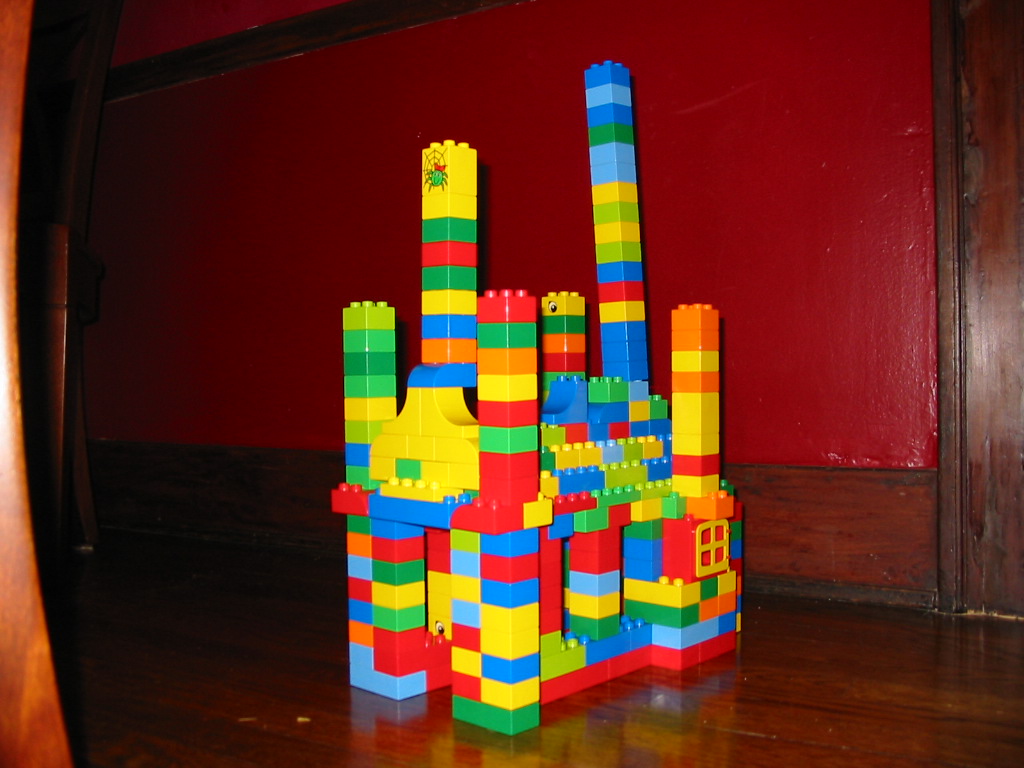
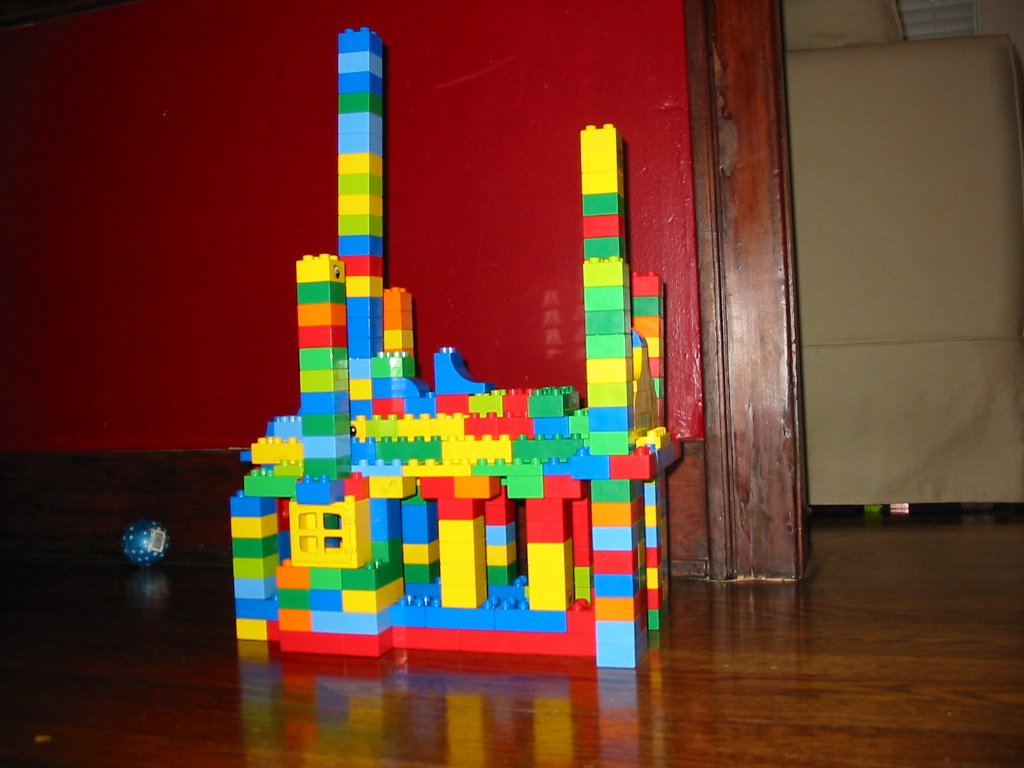
The Curmudgeon children and I built our own church yesterday. We weren't able to do it in Mel Gibson style, without a budget, with limited materials available, and with a short schedule, but we tried. The architectural direction was originally flamboyant gothic--a tribute to the Cathedral of Milan, but we lost our aesthetic focus (not to mention, I had to fire my two-year-old subcontractor in the middle of the job for consistent work below the standard of performance). I think the Kansas City church architects of the 1920s had their projects come off a little better, don't you?

Saturday, November 19, 2005

St. Francis Seraph, Kansas City, Missouri

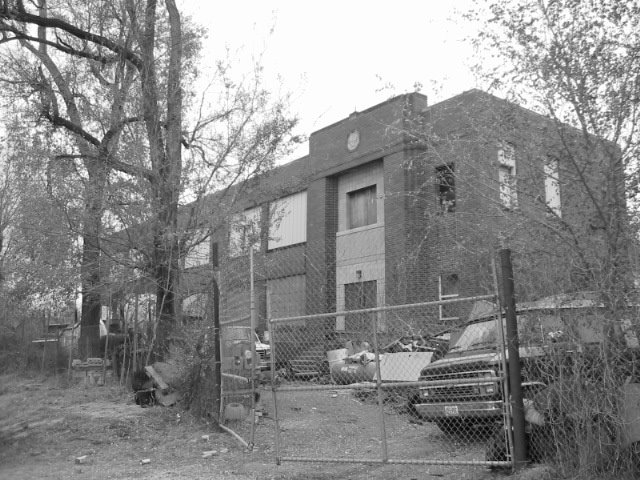
Tucked into the North Bottoms area (off Front Street) in Kansas City, Missouri, in the midst of an industrial area, between two railyards, is a poor, dilapidated residential neighborhood. A kind reader who knows a thing or two about old Kansas City churches suggested I go there to find St. Dominic's. What I found was the the Damascus Road Apostolic Church, formerly St. Francis Seraph. Perhaps it was retitled St. Dominic's at some point. The whole parish plant is a mess. The school is a junkyard, the Rectory has broken windows and an open door. The church has several panels broken out of the stained glass. The remnants of a road grader sit alongside the south transcept.

A woman down the street watched me carefully as I took pictures, so I drove down to visit with her and assure her there was no need to call the police; I was just engaged in a morbid but harmless hobby of mine. I'm glad I did; she had something to say about the place. She couldn't tell me exactly when the church closed, but she said her neighbor knew there was a big auction and everything in the church was sold at one time. She said they had a lot vagrants living in the rectory and at one time a lot of people doing drugs there. The old school building (apparently of late 1940s/early 1950s architecture) is now a junkyard, complete with pitbull (look carefully and you can see him barking at me. She indicated that Queen of Peace was the parish she goes to know (she didn't seem like the type to know whether that was the actual canonical parish for this area now, so I didn't ask). She also tipped me off to Holy Trinity, in the Lykins neighborhood, which I'll post next.

Does anybody have any history on this? When did it close? Why (besides the obvious)? What about the school? What was the interior like?

UPDATE
FEBRUARY 14, 2006

From This Far by Faith. St. Francis Seraph was founded in 1977 by Bishop Hogan, who appointed Fr. William McCormick as Pastor. A small frame church was built in 1887. The parish was to be "mixed," i.e., all nationalities within the geographic boundaries were expected to attend it. The gospel was reread in English, German, Flemish and French, and preaching was in English and German, with French and Flemish on special occastions. A school and a recotry were built by 1897. In 1903, a flood severely damaged the entire parish plant, but they rebuilt. In 1920, land was purchased for a new church to be built in a Lombardy Romanesque style, the one shown above, and the cornerstone was laid in 1924. The parish was always very poor. The school building shown above was built in 1941 at a cost of $37,779, and it was closed in 1962, when the kiddos were packed off to Assumption school. In 1970, the building was sold for $65,000.

Following the 1951 floods, most of the area served by the parish was rezoned and redeveloped as industrial. The parish, which had been served by diocesan priests, and then Franciscans, was given to the care of the Society of Our Lady of the Most Holy Trinity. Don't know anything about 'em. By 1984, there were only 86 Catholics living in 56 households within the parish boundaries.

Effective 1991, St. Francis Seraph was suppressed, along with St. John the Baptist and Assumption, and the three parishes formed St. Anthony of Padua at the Assumption facilities at Benton Blvd and Lexington. The church and rectory were sold to Phoenix Office Supply for $40,000.

Thursday, November 17, 2005

The Conflict

While Mrs. Curmudgeon was recuperating from the birth of the latest little Curmudgeon, we ordered and watched The Conflict, a 78-minute made-for-TV movie from 1973, based on the Brian Moore novel Catholics, starring Martin Sheen and Trevor Howard.

IF YOU DON'T WANT ME TO SPOIL THE MOVIE FOR YOU, QUIT READING NOW!

Anyways, the movie is set in 1999 (then 26 years into the future) and Fr. Cool-Joe (Sheen) is sent to stop monks from an Irish island abbey from saying the old Mass, because people are chartering flights from all over the world to assist at it, such that it's embarrassing the Superior General of their now-enlightened religious order and offending the Church's ecumenical buddies. There's some surprisingly good bits of dialogue in the movie, references to Vatican IV (which forbade private confession), and great contrasts between Fr. Cool-Joe's Marxist-materialist worldview ("I don't know how anyone could define a case of heresy these days") and yoga meditations and the rough-and-tumble monks' defense of the spiritual works of mercy ("but does he talk much about savin' souls, does 'e? I thought not") and singing of old, rigidly Catholic hymns. But in the end, the monastery is sold out by the Abbot, who doesn't really believe in God (the Abbot at one point submits his resignation to Fr. Cool-Joe with the explanation that he's not fit to be Abbot because he lacks faith, but Fr. Cool-Joe tears it up as he leaves, apparently concluding that an atheist is an ideal Abbot in the new Church).

Mrs. Curmudgeon and I (who were both illiterate in 1973--she still in diapers) were surprised that exactly the same sorts of things were said then--just a couple of years following the introduction of the Pauline Missal--as are said now. The dating of the certain details notwithstanding (we managed to preserve private confession--at least officially--beyond 1999), I don't think movie has lost much of its currency. The same battles are being fought--between the Matthew Clarks and Donald Wuerls and the Roger Mahoneys and Walter Kaspars of the church and the traditionalists and other orthodox Catholics who are carrying on with the faith as they always have in out-of-the-way places. The same calls to obedience--the type of unthinking obedience to Churchmen rather than to the Church--are being made, and in the case of the movie, that obedience does in fact lead to heresy (denial of the Real Presence). And there are men who play the role of the Abbot--seemingly faithful men who turnout to be perfidious, and who serve the zeitgeist instead of enforce the perennial disciplines of the church. A certain Colorado bishop comes to mind in this respect.

Anyways, if you haven't already seen it, it's worthwhile to track it down. (I know, I'm probably the only one in the world who hasn't already seen it) it's not something you'll find at Blockbuster, but you can rent it through Netflix or buy it from Amazon for $8 new.

Wednesday, November 16, 2005

And what ABOUT France?

OK, time for me to be curmudgeonly. Folks have been going on and on about the violence in France--primarily the fact that nobody in the maintstream media would admit that it the "youths" were almost exclusively Moslem immigrants. I haven't watched to coverage, so I'm not in a position to critique it.

Remember the Simpsons episode where Homer is hired by Hank Scorpio, the international criminal who manages his evil empire like Ben & Jerry's or something? The conversation at one point goes like this:

Hank: By the way, Homer, what's your least favorite country: Italy or France?

Homer: France.

Hank: [chuckles] Nobody ever says Italy. [sets the coordinates of a giant laser gun]

Really, it would be appalling to see Christendom destroyed like this (that is, by Moslem hoodlums, not by Hank Scorpio), with the deceitful coverage it's getting and all. But c'mon. France ain't Christendom. France hasn't been a Christian country since the 18th century, and hasn't been particularly well governed since the Carolingian empire. France is reaping what it's sown over the last three hundred years. It's sad, I must say, to see the great monuments of the West--Chartres, Amiens, Rouen, Notre Dame de Paris, Mont St. Michel, countless other abbeys and churches--fall into the hands of the infidel. But they've really been in the hands of the infidel for centuries, now, haven't they?

That doesn't lessen my pity for the faithful Christians trying to live there in the cultural ruins of the West, nor does it lessen our obligation to pray for those people, and for the restoration of Christendom. But hey, that pity doesn't extend to the entire country. France is getting France's due.

Old St. Patrick's, Kansas City, Missouri (updated Nov 16)

I was saving this one for last, but due to recent events in my family, I haven't gotten out for further research, or further pictures. So here goes:

Old St. Patrick's Oratory at 8th and Cherry in Kansas City, Missouri, was canonically suppressed as a parish in the 1960s, and was a chapel of convenience within the cathedral parish from that time until October 2005. It was closed last month, but with good reason: it is going to be restored and operated as a public oratory exclusively for the indult Latin Mass community in KCMO, under the care of the Institute of Christ the King, Sovereign Priest. No date has been set for the reopening--lots of work must be done (infrastructure work, as well as restoration of suitable furnishings and decoration) and lots of money must be raised.


Click here for the "shagged out" sanctuary (PDF file).
Click here for pictures of the original (or at least the pre-shag) sanctuary(PDF file).
Click here for pictures of the shagged out sanctuary being dismantled (PDF file).

Kudos to oratory member John Quastler, who produced the bulletins with these pictures and keeps them archived online.

I have quite a bit of information on this parish, as a friend of a friend passed along the entry from This Far by Faith, a history compiled by the diocesan archivist in the 1980s. The abridged version is that the sanctuary was wrecked in the 1970s, with the altar rail mostly removed and the old high altar replaced with a plywood-and-resin clunky altar table, ambo and hanging baldachino left over from some hippy Eucharistic Congress. It's the sort of thing that makes you glad Robert Finn's the bishop and I'm not. I'd have burned somebody at the stake if I'd walked into the church and seen the wanton destruction. Finn doesn't seem inclined to do so; at least not yet.

Anyways, there area lot of challenges in getting this restoration done. The oratory community is small--only 70 or 80 families, I hear, and their resources are meagre. There are no promises that Bishop Finn's successors will permit the Oratory to continue with the old Mass--which makes mistrustful folks a little hesitant to contribute for the infrastructure for it. And even after the community restores the church, they won't have a rectory for their priest to live on-site, nor will they have any area to hold educational or social events. The rectory was torn down in the 1970s, as the second picture shows. Only the garage remains.

But, you've got to admire them and wish them luck (and perhaps make a donation to their restoration fund).

Tuesday, November 15, 2005

Bishop Sheridan and His Man

The Colorado Springs Gazette reports that Peter Howard, a chancery spokesman of some sort for the Bishop of Colorado Springs, Michael Sheridan, has resigned. No reason is given. For a link to that article, click here. A couple of weeks ago, when I first commented on Bishop Sheridan's apology for his own official's attempt to explain church teaching, I had asked if anyone had come up with the "offending" article. Thank's to Google's blogsearch, I found information on another blog this evening, Rick Lugari's De Civitate Dei, which I'm not a regular reader of. It's also available on the Colorado Springs Diocesan website. Since there's a risk that the Diocese will take this down at some point, I'm pasting it in here:

Participation in Protestant Services
Question from Dave on 9 December 2004:

I've been asked whether it is permissable for a Catholic to attend Protestant services. Some schismatic SSPXers I've debated in the past have insisted that this is prohibited, quoting from Pope Pius XI, Mortalium Animos, 1928: Quote:"it is clear that the Apostolic See cannot on any terms take part in their assemblies, nor is it anyway lawful for Catholics either to support or to work for such enterprises; for if they do so they will be giving countenance to a false Christianity, quite alien to the one Church of Christ."

I contend this canonical discipline may have been true in 1928, and could have been interpreted in accord with the 1917 Code of Canon Law, canon 1325 which forbade Catholics to engage in debates or conferences with non-Catholics without the permission of the Holy See. However, even if that included all protestant services as "conferences" instead of merely pan-Christian movement promoting indifferentism, that 1917 canon seems abrogated by Pope Paul VI, NOSTRA AETATE, 1965: Quote:"The Church, therefore, exhorts her sons, that through dialogue and collaboration with the followers of other religions, carried out with prudence and love and in witness to the Christian faith and life, they recognize, preserve and promote the good things, spiritual and moral, as well as the socio-cultural values found among these men." ... as well as the 1983 Code of Canon Law, canon 755. I like your input, however. Is there any current prohibition with regard to Catholics attending Protestant services (assuming no reception of the sacraments), so long as they still meet the obligations to attend Catholic Mass?

Answer by Peter J. Howard, S.T.L. on 10 December 2004:
The heart of your question really is, if I understand you correctly: "Can a Catholic 'participate' in a Protestant liturgical service?" I think Pope John Paul II answered this question clearly in his Encyclical Letter "Ecclesia de Eucharistia" when he stated in number 30: "“It is unthinkable to substitute for Sunday Mass ecumenical celebrations of the word or services of common prayer with Christians from the aforementioned ecclesial communities, or even participation in their own liturgical services. Such celebrations and services, however praiseworthy in certain situations, prepare for the goal of full communion, including eucharistic communion, but they cannot replace it”.

So, the short answer to your question is Catholics cannot "participate" in Protestant liturgical services, even if Catholics fulfill their Sunday Mass obligation. This is primarily because "active participation" as we are called by the Second Vatican Council (Sacrosanctum Concilium # ) involves our body, mind, and spirit (which includes our intentions). When we do that in a Protestant liturgical service we act contrary to our faith which professes fundamentally different beliefs in critical
ecclesiological and theological areas. This is summarized in the theological maxim, "lex orandi lex credendi" (as we pray, so we believe). Catholics can, however, "observe" Protestant services for educational purposes to deepen one's understanding of that particular ecclesial community, but to have the intention to "actively participate" in their liturgical services acts contrary to our Catholic Faith which possesses through the ordained priesthood a valid, sacramental Eucharist which is the means and sign of total communion to which all Protestant churches tend. Protestant churches, despite what they may claim, do not have a valid, sacramental Eucharist because they lack a valid priesthood.

The words you quoted of Pope Pius XI from Mortalium Animos are not "outdated", but must be understood in their proper context which I believe Pope John Paul II provides in Ecclesia de Eucharistia. Pius XI's words are not contrary to ecumenism, but rather protect the Church from a false or misguided ecumenism which confuses the identity, purpose, and mission of the Catholic Church which possesses the fullness of truth and communion with Jesus Christ with something less. The goal of ecumenism is to bring all into fullness of communion with Jesus Christ in "one, holy, catholic, and apostolic" church as we profess every Sunday. We do this through honest and charitable dialogue, fervent prayer, and challenging our Protestant brothers and sisters to seek the truth. Dialogue for the sake of dialogue is fruitless. It must be an honest dialogue seeking the truth and the intention of Jesus Christ.
God bless you.


Later, in response to a letter to the editor of the diocesan paper from a priest, Mr. Howard stuck to his guns:

Response to Letter to Editor Re: "Why not attend 'New Life'?"
By Peter J. Howard, S.T.L. 21 October 2005
Thank you, Father Slattery, for your thoughtful response. I would like to take this time to offer some needed clarifications based upon matters raised in your letter.
It is important to note that there are two reasons for a Catholic attending a non-Catholic denomination’s liturgical service. The first applies to weddings and funerals of non-Catholic Christians, where a Catholic may attend that service out of respect for the one being married or the one being buried. This is not what my column was addressing. My column addressed the second reason, namely, that Catholics attend a non-Catholic liturgical service to share in the faith of that particular assembly. This is the problem addressed by Pope Pius XI and by the Second Vatican Council’s Decree on Ecumenism as cited below. Catholics who attend funerals or weddings of non-Catholics are not there to express their faith in that denomination. They are usually there simply out of human respect.

The same cannot be said for those who attend other denomination’s liturgical assemblies where the purpose of that assembly is to express that community’s particular Christian faith, which is not compatible with Catholicism. I am
troubled by your statement regarding Catholics being told “they could not attend weddings of Catholics in a non-Catholic church.” This is not something that has changed since Vatican II. Catholics are bound to observe canonical form when they marry. Unless a dispensation from form was granted through the bishop, they remain bound to observe it. Any attempt otherwise results in an invalid marriage and the couple’s manifest scandal to the church. This is the teaching of the Catholic Church and for Catholics to think it is OK to witness what they know to be an invalid marriage in the eyes of the church only adds to that scandal. This certainly has not changed since Vatican II.

The vespers service you alluded to at St. Peter’s Basilica in Rome was an “ecumenical service” which is not the same as a Protestant community’s liturgical service for their own assembly. The ecumenical prayer service is a jointly-organized prayer service focusing on common elements of faith between the Catholic Church and participating Christian communities, while Protestant churches’ particular liturgical service is an
expression of their particular faith which, “on account of their origins, and different teachings in matters of doctrine vary considerably, not only with us, but also among themselves,” [Vatican II, Decree on Ecumenism, 19] although there may be common elements of faith between Protestant communities and the Catholic Church.
One further clarification, the Assisi gatherings convened by John Paul II were not ecumenical, but inter-religious events. Moreover, the various religious faiths (Christian, Muslim, Jew, Hindu, et al.) never “prayed together,” but, as John Paul stated, “came together to pray” according to their respective religious faiths and in different sections of Assisi when it came time for the various religions to pray for peace.

It is true that the Second Vatican Council ushered in a new ecumenical age of the church, as evidenced in its Decree on Ecumenism, “Unitatis Redintegratio” [UR]. However, there remains misunderstanding by some as to what true “ecumenical sensitivity” entails. The church has never taught that random participation in Protestant liturgical services as an authentic expression of Catholic faith is acceptable or even ecumenical. Nowhere is this promoted in Vatican II or any other official teaching of the Catholic Church. In fact, UR states the opposite in No. 8: “Worship in common is not to be considered as a means to be used indiscriminately for the restoration of Christian unity” — and precisely for the reasons you list at the end of your letter. When this teaching is compromised, even with the best of intentions, Catholics endanger their salvation by being misled by false doctrines, expose the church to potential scandal by giving the appearances of belonging to a non- Catholic church, or even lose their Catholic faith.


Catholics must ask themselves, “Do I truly believe that the Catholic Church is the one and only church founded by Jesus Christ, has possessed and faithfully transmitted the fullness of truth for 2000 years, is the mainstream and instrument of God’s grace and possesses the greatest gift of all: the Body, Blood, Soul and Divinity of Jesus Christ truly present in the Holy Eucharist?” If I do, then why would I ever entertain the thought of participating in any other denomination’s liturgical assemblies which cannot claim the same? How is this treasury of the Catholic Church ever insufficient? How can it ever be exhausted?

Well, Mr. Howard isn't some closet traditionalist--he's making up excuses and parsing things quite finely in order to defend the current order of business when it comes to non-Catholic sects. This response calls further into question Bishop Sheridan's apology, which ran in the Gazette on October 21:

Local Catholic diocese believes in ecumenism

Recently, my assistant Peter Howard gave an interview to The Gazette regarding relations of Catholics with non-Catholics. The result of that interview was an article in Monday’s Gazette (“Protestant services not OK for Catholics,” Life). While I do not believe that it was intended, many people were offended. While Howard is free to express his opinions as a Catholic layman, the interview was done without my knowledge or direction and does not represent my thinking on the subject. Nevertheless, I am deeply sorry for any hurt or insult that has been experienced, and I humbly ask that all men and women of good will accept my apology. The Catholic church is irrevocably dedicated to the ecumenical movement, which found its modern impetus in the Second Vatican Council. That council urged all Catholics to engage in the work of ecumenism “in fidelity to the truth and with a spirit of good will.” I want nothing but good will to prevail in our community. In all denominations there is a desire to retain members and help them grow in the faith they have professed. However, that concern for the spiritual well-being of our members must never express itself in ways that hurt our brothers and sisters in Christ. Even more, it should be unthinkable that we demean the teachings or disciplines of denominations other than our own or engage in name-calling of any kind. The many Christian denominations remain separated from each other to one degree or another. But all who have the name “Christian” rejoice in a unity that comes from our common faith in Jesus Christ. Even though we may not yet be sharing fully in worship with one another, there is so much we can and ought to be doing together. Not least among the ways that we can express our solidarity is by engaging in projects that benefit our fellow Christians and, indeed, all in the human family. I want all to know that I remain steadfastly committed to the ecumenical endeavor begun four decades ago and I dedicate myself to the first and most fundamental dimension of ecumenical relations — mutual respect and friendship.

Bishop Michael J. Sheridan Colorado Springs

One less Bishop on my honor roll, and one (now former) lay chancery official (imagine that, me praising a lay chancery official!) to add to it. Kudos to you, Mr. Howard for (1) earning a licentiate in sacred theology in this day and age without losing your faith, (2) speaking the truth, (3) not backing down from it, even though it meant you had to quit or get fired by Sheridan.


Friday, November 11, 2005

Brief Hiatus

Positive developments in the Curmudgeon household, but such that my attention will be diverted from the blog for about a week. See you then.